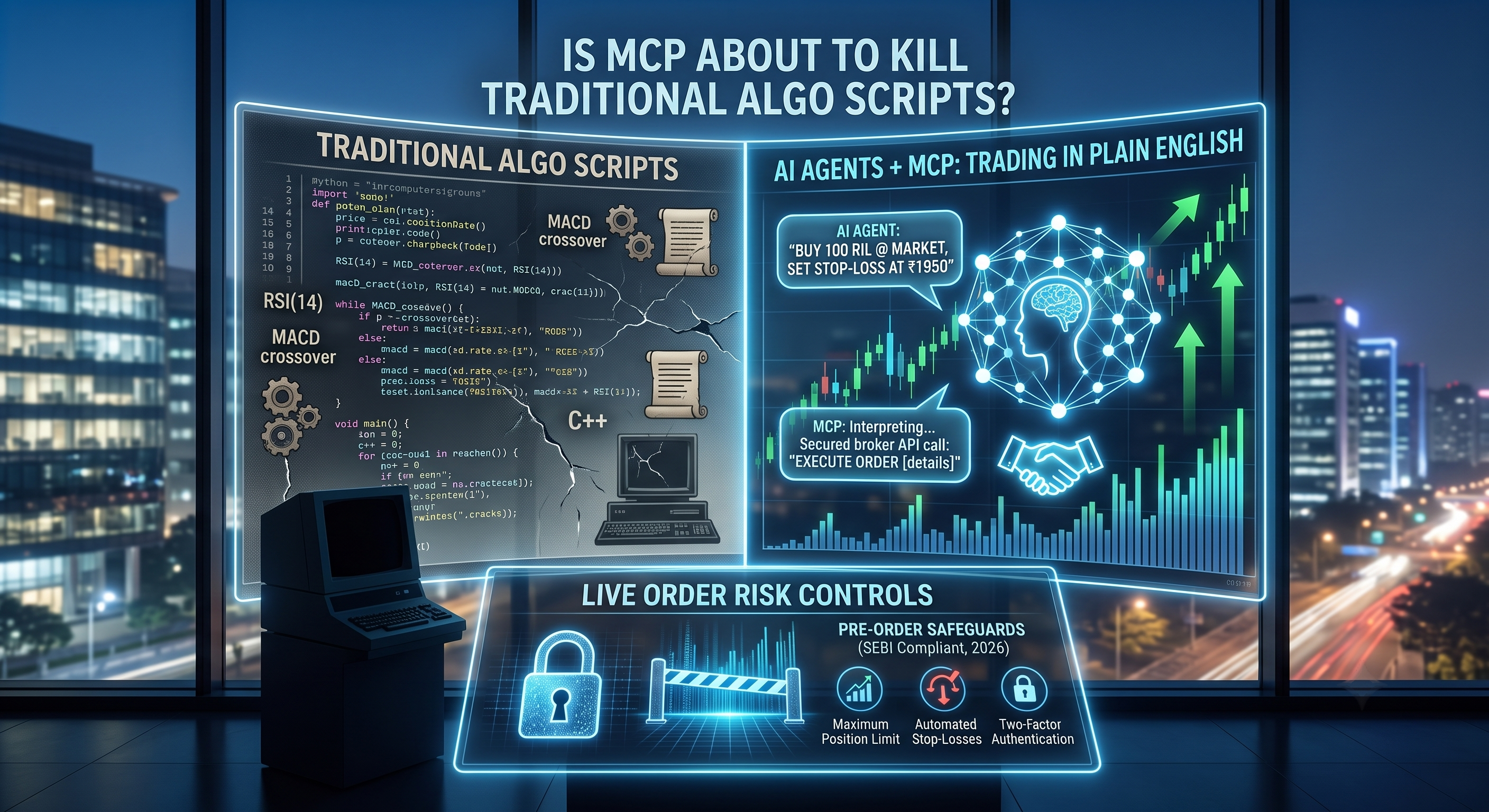
Is Model Context Protocol About to Kill Traditional Algo Scripts—Or Is It Just Hype?
A claim making the rounds lately goes something like this: broker APIs are being replaced by AI agents that trade in plain English, and traditional algo scripts are on their way out. It's an exciting pitch, and there's a real shift underneath it — but the reality on the ground today is narrower than the headline suggests. This article breaks down what Model Context Protocol (MCP) actually is, how it's genuinely being used in trading right now, and the precautions that matter if you're experimenting with it yourself.
What Is Model Context Protocol (MCP), Actually?
MCP is an open standard — originally introduced by Anthropic — for connecting AI models to external tools and data sources in a structured way. Instead of a developer writing custom glue code every time an AI assistant needs to call an API, MCP defines a common format: a server exposes a set of "tools" (fetch a quote, place an order, check margin), and any MCP-compatible AI client can discover and call those tools directly.
Applied to trading, an MCP server sits between an AI agent and a broker's existing API. It doesn't replace the broker's order-management system or bypass any exchange infrastructure — it's a translation layer. You (or the agent) express an instruction in natural language; the MCP server converts that into the same structured order request the broker's API always expected, and the response comes back the same way.
How MCP Is Actually Being Used in Trading Today
This is where it's worth separating signal from hype. As of now, MCP adoption in trading looks like this:
- Mostly community-built, not broker-native. Open-source developers have built MCP servers that wrap the APIs of specific brokers and platforms — including community projects for Indian broker APIs, and official or semi-official MCP servers from platforms like Alpaca and MetaTrader. These sit on top of existing, already-public broker APIs; they are not, in most cases, a new capability the broker itself is officially shipping and supporting.
- Framework-level, not strategy-level. MCP standardizes how an AI agent calls a broker's tools. It doesn't itself decide when to trade — that logic still comes from whatever model or system prompt is directing the agent, which means strategy quality and risk management still work exactly the way they do in any other algo trading setup.
- Strongest fit so far: research, monitoring, and staged execution. Fetching quotes, summarizing positions, screening for setups, and preparing (but not necessarily auto-firing) orders are the workflows where natural-language agents are genuinely useful today. Fully autonomous, unsupervised order placement is a much smaller and riskier slice of current usage.
In other words: the underlying shift — AI agents interacting with markets through standardized tool calls instead of bespoke integration code — is real and growing. The idea that it has already replaced traditional algo scripts for most traders is ahead of where the ecosystem actually is.
MCP-Driven Agents vs Traditional Algo Scripts
| Factor | Traditional Algo Script | MCP-Driven AI Agent |
|---|---|---|
| Instruction format | Hard-coded rules and conditions | Natural language, interpreted by the model at runtime |
| Predictability | Deterministic — same input always gives same output | Probabilistic — the model's interpretation can vary between runs |
| Development effort | Requires writing and maintaining integration code per broker | Standardized tool calls reduce integration overhead |
| Auditability | Every decision traces to an explicit rule in code | Requires logging the agent's reasoning and tool calls to reconstruct why a trade happened |
| Best suited for | High-frequency, rule-based, latency-sensitive strategies | Research, monitoring, discretionary-style setups, staged execution |
| Regulatory footing in India | Well-established under SEBI's algo trading framework | Still subject to the same SEBI framework — Algo-ID tagging and broker-level risk checks apply regardless of what generated the order |
Why "Autonomy" Needs Guardrails
The appeal of an MCP-connected agent is that it can reason over a market setup, check your portfolio risk, and stage a trade in one continuous flow instead of you switching between five different screens. But letting a language model — which is fundamentally a probabilistic system — place live orders without safeguards is a different risk profile than a deterministic script executing pre-tested rules. A few precautions matter more here than in traditional algo trading, not less:
- Keep a human in the loop. Require explicit, one-click confirmation before any order actually reaches the market, at least until an agent's behavior has been observed extensively in a controlled setting.
- Hard-code risk controls outside the model. Maximum order size, per-trade risk, and daily loss limits should be enforced at the broker or MCP server layer — as non-negotiable code — not left to a system prompt instruction the model could misinterpret, ignore under unusual phrasing, or have overridden by a poorly worded follow-up message.
- Match the tool to the timeframe. Agentic, conversational execution has real latency — the round trip of reasoning, tool selection, and confirmation takes meaningfully longer than a compiled rule firing on a tick. It's a reasonable fit for swing or positional trading; it is not a substitute for high-frequency or scalping infrastructure.
- Log everything. Because the agent's reasoning isn't visible in the same way a line of code is, maintaining a full audit trail of prompts, tool calls, and outputs is what makes the system reviewable after the fact — this is also relevant to SEBI's expectation of traceable, auditable algo activity.
What This Means for the SEBI Compliance Picture
It's worth being clear that MCP doesn't create a shortcut around India's algo trading regulations. SEBI's retail algo trading framework — which became fully mandatory on April 1, 2026 — requires exchange-assigned Algo-ID tagging and broker-level risk checks on algorithmic orders. That requirement doesn't distinguish between an order generated by a hard-coded Python script and one generated by an AI agent through an MCP tool call: if software is placing the order based on predefined logic (even natural-language-directed logic), it still needs to flow through the same broker API infrastructure and sit inside the same compliance structure covered in SEBI's framework. An MCP layer changes how the instruction is expressed — it doesn't change who's accountable for the resulting order.
Common Myths vs Reality
Myth: "MCP means brokers have replaced their APIs with AI-native infrastructure."
Reality: In most cases today, MCP servers are a layer built on top of a broker's existing, unchanged API — not a replacement for it.
Myth: "Natural-language agents are now the standard way retail traders execute in India."
Reality: Adoption is still early and concentrated among developer-heavy, experimental users. Most retail algo trading in India continues to run on traditional scripted strategies through broker APIs.
Myth: "MCP makes a strategy smarter."
Reality: MCP standardizes how an agent talks to a broker — it says nothing about whether the underlying trading logic or the model's judgment is sound. A bad strategy expressed in natural language is still a bad strategy.
Myth: "If it's AI-driven, it doesn't need the same risk controls as a script."
Reality: The opposite is closer to true — probabilistic systems generally need tighter, code-enforced guardrails than deterministic ones, not looser ones.
Frequently Asked Questions
What is Model Context Protocol (MCP) in simple terms?
MCP is an open standard that lets AI models call external tools — like a broker's order-placement or quote-fetching functions — in a consistent, structured way, instead of every integration needing custom code.
Is MCP replacing traditional algo trading scripts?
Not yet, and not wholesale. MCP is mostly being used today for research, monitoring, and staged execution workflows built on top of existing broker APIs. High-frequency and strictly rule-based strategies still rely on traditional scripted execution.
Do Indian brokers officially support MCP?
Community-built MCP servers exist that connect to various brokers' existing APIs, but broker-native, officially supported MCP endpoints are not yet the norm. Availability changes quickly in this space, so check a specific broker's current developer documentation before relying on any MCP integration.
Is it safe to let an AI agent place live trades automatically?
It carries meaningfully more risk than a tested, deterministic script unless strict guardrails are in place — human confirmation before execution, hard-coded (not prompt-based) risk limits, and thorough logging are widely recommended precautions.
Does using an AI agent change SEBI compliance requirements?
No. SEBI's algo trading framework applies based on whether software is placing orders according to predefined logic, regardless of whether that logic is a Python script or an AI agent's reasoning. Algo-ID tagging and broker-level risk checks still apply.
Is MCP-based trading suitable for scalping or high-frequency strategies?
Generally not. The reasoning and tool-call round trip involved in agentic execution adds latency that's a poor fit for strategies that depend on sub-second reaction times. It's a better fit for swing or positional trading.
Conclusion
Model Context Protocol is a genuine, useful shift in how AI agents interact with broker infrastructure — but it's an integration standard, not a trading strategy, and it hasn't displaced traditional algo scripts for most of what retail traders actually do today. The realistic framing is closer to "a new interface option with its own risk profile" than "the end of scripted trading." If you're experimenting with it, treat an AI agent the way you'd treat any new execution system: assume it needs more oversight, not less, until it's proven otherwise — human confirmation, hard-coded risk limits, and full audit logs first, autonomy later.
Related Reads
- How Indian Brokers Support Algo Trading
- Is Algo Trading Legal & Profitable in India?
- 10 Costly Intraday Trading Mistakes
Tools, integrations, and regulatory requirements in this space change quickly. Always verify current capabilities directly with your broker and current SEBI circulars before connecting any AI agent or automated system to a live trading account. This article is for informational purposes only and does not constitute investment or technical advice.
Preview: Is Model Context Protocol About to Kill Traditional Algo Scripts—Or Is It Just Hype? A claim making the rounds lately goes something like this: broker APIs are being replaced by AI agents that trade in plain English, and traditional algo scripts are on their way out. It's an exciting pitch, and there's a real shift underneath it — but the reality on the ground today is narrower than the headline suggests. What Is Model Context Protocol (MCP), Actually? MCP is an open standard, originally introduced by Anthropic, for connecting AI models to external tools in a structured way. Applied to trading, an MCP server sits between an AI agent and a broker's existing API as a translation layer — it doesn't replace the broker's order-management system or bypass exchange infrastructure. How MCP Is Actually Being Used in Trading Today Mostly community-built, not broker-native — open-source MCP servers wrap existing broker APIs rather than brokers officially shipping the capability themselves. Framework-level, not strategy-level — MCP standardizes tool calls; it doesn't decide when to trade. Strongest fit so far: research, monitoring, and staged execution, not fully autonomous unsupervised order placement. MCP-Driven Agents vs Traditional Algo Scripts Comparison table across instruction format, predictability, development effort, auditability, best-suited use case, and regulatory footing in India — traditional scripts remain deterministic and well-established; MCP agents are more flexible but probabilistic, and carry the same SEBI obligations regardless. Why "Autonomy" Needs Guardrails Keep a human in the loop with one-click confirmation before execution. Hard-code risk controls (max order size, per-trade risk, daily loss limits) at the broker/MCP server layer, not in the system prompt. Match the tool to the timeframe — good for swing/positional trading, not high-frequency scalping. Log everything for auditability. What This Means for the SEBI Compliance Picture MCP doesn't bypass SEBI's algo trading framework. Algo-ID tagging and broker-level risk checks apply the same way whether an order comes from a hard-coded script or an AI agent's natural-language instruction — an MCP layer changes how the instruction is expressed, not who's accountable for the order. Common Myths vs Reality Covers four misconceptions: that brokers have replaced their APIs with AI-native infrastructure, that natural-language agents are now the retail standard in India, that MCP makes a strategy smarter, and that AI-driven trading needs less risk control than scripted trading. FAQ — 6 questions covering what MCP is in simple terms, whether it's replacing algo scripts, Indian broker support, safety of autonomous AI trading, SEBI compliance implications, and suitability for high-frequency strategies. Conclusion — MCP is a genuine, useful integration standard, not a trading strategy, and hasn't displaced traditional algo scripts for most retail trading today. Treat AI agents as needing more oversight, not less, until proven otherwise. Related Reads: How Indian Brokers Support Algo Trading | Is Algo Trading Legal & Profitable in India? | 10 Costly Intraday Trading Mistakes Tools, integrations, and regulatory requirements in this space change quickly. Always verify current capabilities directly with your broker and current SEBI circulars before connecting any AI agent or automated system to a live trading account. This article is for informational purposes only and does not constitute investment or technical advice.