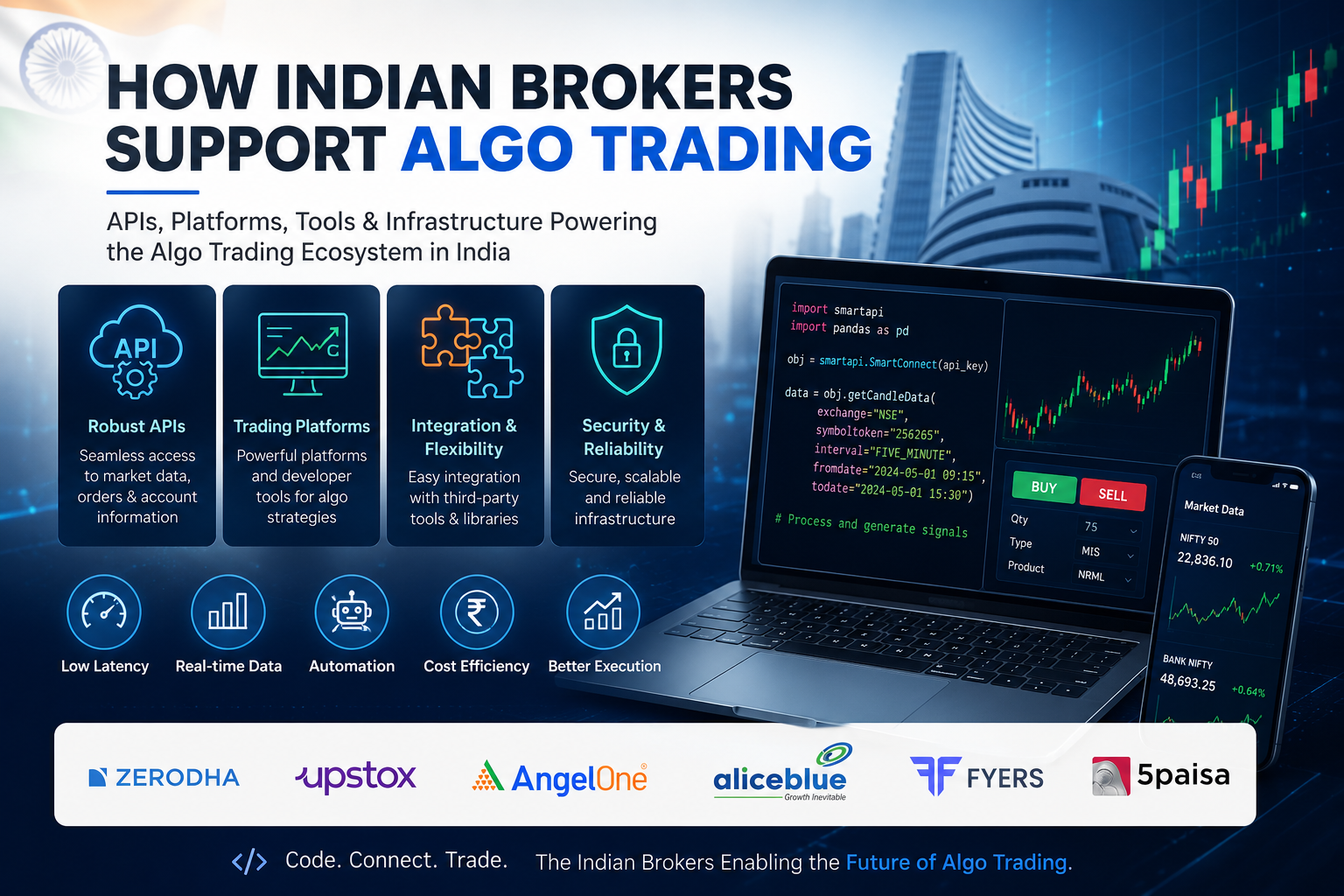
How Indian Brokers Support Algo Trading
Algo trading in India has moved from a niche, institutional activity to something a large number of retail traders now do through their own broker's API. Almost every major broker — Zerodha, Angel One, Upstox, and several others — now publishes a developer API that lets you place orders, pull market data, and manage your portfolio programmatically, instead of clicking buttons in a trading app.
This guide stays deliberately general. Brokerage rates, API subscription costs, and rate limits change often enough that any specific numbers go stale within months. What doesn't change as quickly is how these APIs work, what SEBI now requires of every broker offering algo trading, and how to think through choosing and setting one up. For current pricing and limits, always check the broker's own developer documentation directly before you commit to anything.
What "Algo Trading via a Broker API" Actually Means
When people talk about algo trading with a broker like Zerodha or Angel One, they usually mean one of two things:
- Writing your own code that talks directly to the broker's API — placing orders, fetching quotes, and managing positions based on logic you've written yourself.
- Using a third-party platform — such as Streak, Tradetron, or AlgoTest — that sits on top of a broker's API and gives you a no-code or low-code way to build and run strategies, without you writing the underlying integration code.
Either way, the broker's API is the layer that actually executes your strategy in the market. Your choice of broker matters in both cases, since third-party platforms only support brokers they've built an integration with.
How a Broker API Generally Works
Despite differences in naming and documentation style, most Indian broker APIs follow a similar shape:
- Authentication. You register as a developer on the broker's portal, create an "app," and receive an API key and secret. Most brokers use a login-and-token flow where you authenticate once (often via a redirect through the broker's login page) and receive an access token used for subsequent requests.
- Order placement. REST endpoints let you place, modify, and cancel orders — market, limit, stop-loss, and so on — the same order types available through the broker's regular trading app.
- Portfolio and account data. Endpoints to fetch your holdings, positions, margins, and order/trade history, so your strategy can check its own state before acting.
- Market data. Live quotes and market depth, usually delivered through a WebSocket connection for real-time updates, alongside REST endpoints for historical candle data used in backtesting.
- Rate limits. Every broker caps how many requests or orders you can send in a given time window. These limits differ by broker and by endpoint, and are worth checking directly on current documentation rather than assuming — they're one of the more frequently revised aspects of any broker's API.
Documentation quality, SDK support (Python, Java, Node.js, and so on), and the activity level of a broker's developer community vary a fair amount. A well-documented API with an active forum will generally save you significant development time compared to one with sparse docs and little community support — this is worth weighing more heavily than most other factors when picking a broker for algo trading specifically, since it directly affects how long it takes you to get a strategy working correctly.
SEBI's Algo Trading Framework: What It Requires
SEBI introduced a formal regulatory framework for algorithmic trading by retail investors, which became fully mandatory from April 1, 2026. The core requirements apply to every broker offering algo trading in India, regardless of size:
- Algo-ID tagging. Every algorithmic order placed through an API must be tagged with an exchange-assigned Algo-ID, so exchanges can trace which algorithm generated a given order.
- Broker-level risk checks. Brokers must apply risk management checks to algorithmic orders before they reach the exchange, rather than passing every API order through unchecked.
- Broker accountability. The broker is held responsible for algo products running on their platform, which is part of why brokers have tightened onboarding and infrastructure requirements around API access.
- A different path for strategy providers. If you're using your own strategy purely on your own account, brokers generally handle Algo-ID tagging on the backend without much friction for you. If you intend to distribute a strategy to other users — running it as a product for others rather than just yourself — that falls under a separate, more involved registration process: you'd need to formally register as an algo provider and get empanelled with a broker, rather than simply using a personal API key.
This framework is the same across brokers in terms of what's required; what differs is how smoothly each broker has implemented it and how much friction (if any) it adds during onboarding.
Infrastructure Considerations Worth Knowing About
A few practical, broker-side requirements come up often enough for algo traders that they're worth understanding conceptually, even without pinning down specifics:
- Static IP requirements. Several brokers now require API access to come from a static IP address, as part of tightened security expectations tied to the regulatory framework. This is a genuine hurdle if you're running your strategy from home broadband, since most retail connections don't come with a static IP by default — many traders end up using a small cloud server specifically to get one.
- Sandbox/testing environments. Not every Indian broker offers a true sandbox for testing order flow without risking capital. It's worth checking a broker's current developer docs directly on this point, since the absence of a sandbox generally means building your own internal simulation layer before going live.
- Developer-specific support. API issues often need a different kind of support than a general trading helpdesk can provide. Brokers with a dedicated developer forum or technical support channel tend to resolve API-specific problems faster than those where every query goes through general customer support.
How to Evaluate a Broker for Algo Trading
Rather than comparing specific numbers that will be outdated soon, it helps to evaluate brokers along a few durable dimensions:
- API documentation and reliability — how current the docs are, whether there's a changelog for breaking changes, and how responsive the developer community or support channel is.
- Ecosystem — whether the broker is well-supported by third-party no-code/low-code platforms, which matters if you'd rather not build everything from scratch.
- Data access model — whether live and historical market data are bundled with API access or handled separately, since this affects both cost and how you architect your strategy's data pipeline.
- Regulatory readiness — how smoothly the broker has implemented SEBI's Algo-ID and risk-check requirements, and how much onboarding friction that adds.
- Infrastructure fit — whether you can meet requirements like static IP access from your current setup, or whether you'll need to move to a cloud server.
For anything cost-related — brokerage, API subscription fees, or rate limits — check the broker's official developer documentation at the time you're actually setting up, rather than relying on any article (including this one) for current figures.
Major Brokers Offering Algo Trading APIs
Zerodha (Kite Connect), Angel One (SmartAPI), and Upstox (Developer API) are among the most widely used broker APIs for retail algo trading in India, each with an established developer ecosystem and third-party platform integrations. Beyond these three, brokers including Shoonya (Finvasia), Fyers, Dhan, Alice Blue, IIFL Securities, and Pocketful also publish documented APIs, with differences in areas like charting tools, options-strategy focus, or commodity coverage. Since specific API features and terms are revised periodically, it's worth checking each broker's current developer documentation directly if a particular capability — such as native TradingView execution or MCX coverage — matters for your strategy.
Getting Started: The General Process
Onboarding looks broadly similar across brokers:
- Open or use an existing trading and demat account, since API access is tied to an active account rather than sold as a standalone product.
- Register as a developer on the broker's portal and create an app to generate your API key and secret.
- Set up infrastructure as required — including a static IP if the broker mandates one for API access.
- Review current rate limits and documentation before writing strategy code, so your design accounts for them from the start rather than needing a rewrite later.
- Test before going live — using a sandbox if the broker offers one, or a self-built simulation layer if it doesn't.
- Understand your SEBI obligations — Algo-ID tagging is generally handled by the broker if you're trading only your own account; distributing a strategy to others requires formal empanelment as an algo provider.
Common Mistakes to Avoid
- Choosing a broker on brand recognition alone, rather than API quality, documentation, and ecosystem fit.
- Not checking rate limits before designing a strategy, then discovering mid-build that the broker can't support the order or polling frequency you need.
- Assuming home broadband will work for API access, without checking a broker's static IP requirements ahead of time.
- Treating API pricing and data costs as an afterthought, rather than confirming them directly on current documentation before building around a specific broker.
- Not distinguishing between using your own strategy and distributing one to others — the second path has materially different SEBI registration requirements.
Frequently Asked Questions
Do all Indian brokers support algo trading?
Not universally, but most major brokers now publish a documented trading API, and all brokers offering algo trading must comply with SEBI's Algo-ID and risk-check requirements as of April 1, 2026. Coverage and API maturity still vary by broker, so it's worth checking a specific broker's developer documentation to confirm current support.
Does Zerodha support algo trading?
Yes. Zerodha supports algo trading through its Kite Connect API, and is one of the most widely used broker APIs in India for this purpose, with a large ecosystem of third-party tools built on top of it, such as Streak and Sensibull.
Do I need to register with SEBI to run my own algo strategy?
If you're running a strategy purely on your own trading account, your broker generally handles the required Algo-ID tagging on the backend without a separate registration step from you. Formal registration as an algo provider, with broker empanelment, is required if you plan to distribute your strategy for other people to use.
Is a static IP always required for API access?
It depends on the broker — several now require one as part of tightened security expectations, while others don't. Check the specific broker's current developer documentation, since this requirement (and how it's enforced) can change.
Which broker API is fastest?
Reliable, verified head-to-head latency comparisons across Indian broker APIs are limited and change with infrastructure updates on either side, so it's best not to rely on general reputation or marketing claims. Execution speed depends on multiple factors beyond the broker's API itself — your own server's location and network quality, how the exchange is processing orders at that moment, and general market conditions during volatile periods. If speed matters for your strategy, testing order placement and data latency empirically from your own setup, across your shortlisted brokers, is the most reliable approach.
Broker APIs, pricing, and SEBI compliance requirements are revised periodically. Always verify current details directly on each broker's official developer documentation before making a decision. This article is for informational purposes only and does not constitute financial advice.