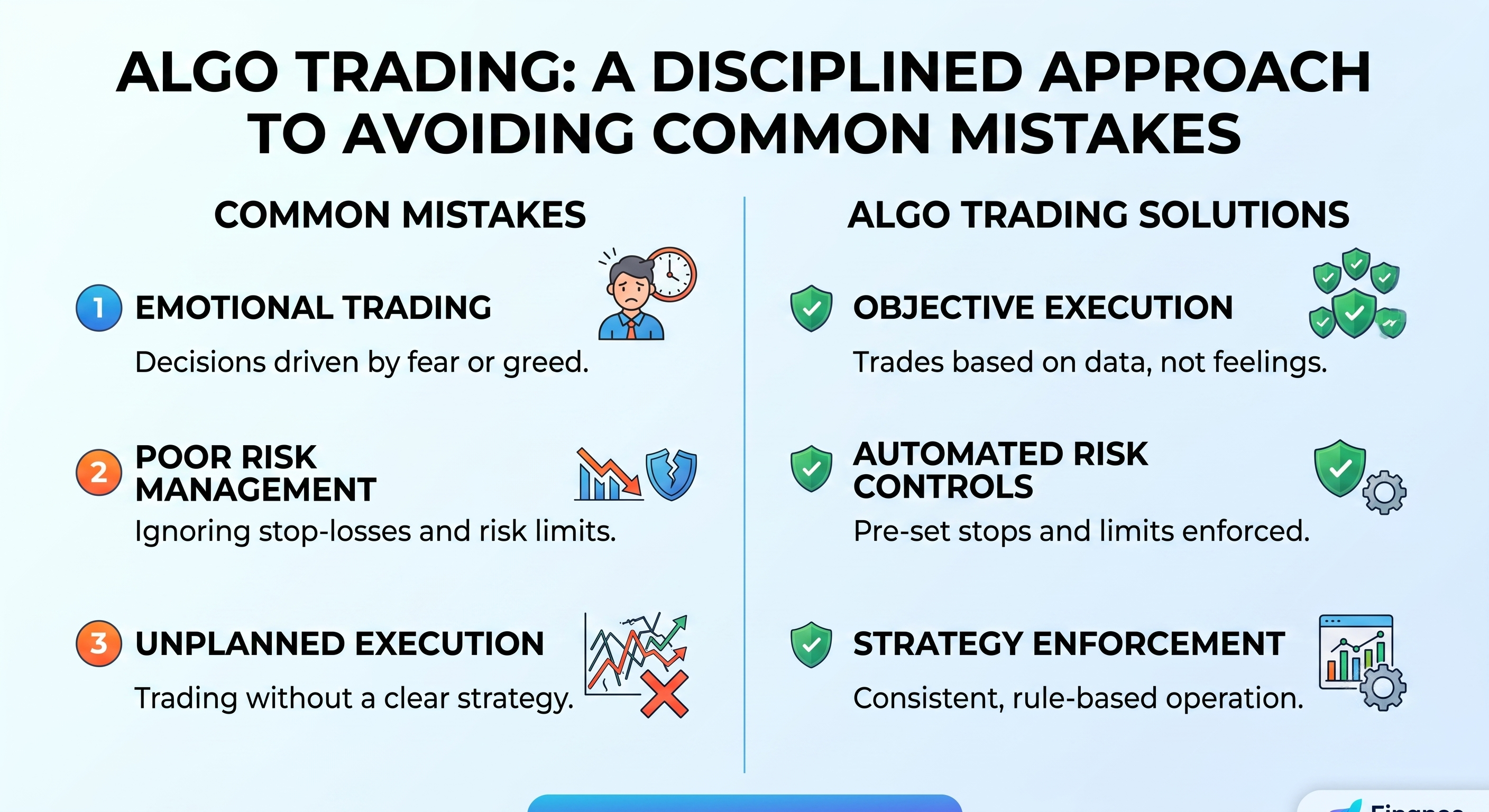
10 Costly Intraday Trading Mistakes (And How Algo Trading Tools Prevent Them)
Most people who try intraday trading lose money — not because the stock market is rigged, and not because they lack intelligence, but because of a handful of repeated, avoidable errors. If you've ever wondered why your trades look good on paper but your account balance tells a different story, you are not alone. Data from India's own market regulator has repeatedly shown that a majority of individual intraday traders end up with net losses over time.
Here's the part most beginners get wrong: they spend months hunting for the "perfect strategy," a magic indicator combination, or a secret setup that guarantees profits. In reality, consistently profitable traders rarely have a secret formula — they simply avoid the same costly mistakes in intraday trading that wreck everyone else's accounts. Avoiding mistakes is a far more reliable path to consistency than chasing perfection.
In this guide, you'll learn the 10 most common and costly mistakes in intraday trading, why traders keep making them, real-world examples of how they play out, and practical, actionable solutions. We'll also look at how modern algorithmic trading software and disciplined intraday risk management tools can help remove the emotional and behavioral errors that quietly destroy trading accounts.
Quick Summary: 10 Intraday Trading Mistakes at a Glance
| Mistake | Why It Happens | Solution |
|---|---|---|
| Trading without a plan | Impulse-driven decisions, FOMO | Write a rule-based trading plan before market hours |
| Ignoring stop loss | Hope that price will "come back" | Set stop loss at order placement, never move it wider |
| Overtrading | Boredom, chasing every move | Cap trades per day; trade only high-probability setups |
| Revenge trading | Emotional reaction to a loss | Enforce a mandatory cooling-off period after a loss |
| Emotional trading | Fear and greed override logic | Use predefined, mechanical entry/exit rules |
| Following tips blindly | Shortcut to "easy" profits | Verify every tip with your own analysis first |
| Poor risk management | No fixed risk-per-trade limit | Risk only 1–2% of capital per trade |
| Trading illiquid stocks | Chasing cheap or "hot" small caps | Trade only high-volume, liquid stocks |
| Incorrect position sizing | Guesswork instead of calculation | Size positions based on stop-loss distance and capital |
| Not maintaining a journal | Seen as extra, unnecessary work | Log every trade with reasoning and outcome |
The 10 Costly Intraday Trading Mistakes Explained
1. Trading Without a Plan
What it is: Entering trades based on gut feeling, a chart that "looks good," or sudden excitement — with no predefined entry, target, or exit rule.
Why traders make it: Planning feels slow when the market is moving fast, and beginners often assume experienced traders "just know" when to enter.
Real-world example: A trader sees a stock spike 3% in five minutes and buys immediately, without checking volume, trend, or a defined target — only for the price to reverse just as quickly.
Consequences: Random entries lead to random results. Over time, this inconsistency erodes both capital and confidence.
Solution: Before the market opens, write down your setup criteria, entry trigger, stop-loss level, and target for every trade you plan to take. If a trade doesn't meet your written criteria, skip it.
How algo trading helps: Algorithmic trading software executes trades strictly based on pre-coded rules, removing impulsive, plan-less entries entirely.
2. Ignoring Stop Loss
What it is: Skipping the stop loss altogether, or moving it further away once a trade starts moving against you, hoping the price will recover.
Why traders make it: Loss aversion — psychologically, realizing a loss feels worse than an unrealized one, so traders avoid "locking it in."
Real-world example: A trader buys a stock expecting a quick 1% move, skips the stop loss to "save on brokerage," and watches a 1% dip turn into a 6% loss by the end of the day.
Consequences: One unmanaged loss can wipe out gains from several winning trades.
Solution: Always place your stop loss the moment you enter a trade, and treat it as non-negotiable.
Warning: Widening a stop loss mid-trade is one of the fastest ways to turn a small loss into a devastating one.
How algo trading helps: Automated systems attach and execute stop-loss orders instantly and unemotionally, with no hesitation or second-guessing.
3. Overtrading
What it is: Taking far more trades than your strategy or capital justifies, often just to "stay active" in the market.
Why traders make it: Boredom during slow sessions, fear of missing out (FOMO), or the mistaken belief that more trades equal more profit.
Real-world example: A trader with a plan for 2–3 quality trades a day ends up taking 15, most of them low-probability setups, simply because the market was "moving."
Consequences: Higher brokerage and transaction costs, increased exposure to poor setups, and mental fatigue that clouds judgment.
Solution: Set a hard daily cap on the number of trades, and only take setups that fully match your criteria.
How algo trading helps: Algo systems only fire trades when strategy conditions are genuinely met, naturally filtering out low-quality, impulsive trades.
4. Revenge Trading
What it is: Immediately jumping into a new trade after a loss, driven by a need to "win it back" rather than a valid setup.
Why traders make it: Frustration and ego — losses feel personal, and the instinct is to fight back rather than step away.
Real-world example: After a stop loss hits, a trader doubles the position size on the very next trade to recover the loss quickly — and loses even more.
Consequences: A single bad trade can spiral into a series of increasingly reckless ones, sometimes wiping out an entire day's or week's capital.
Solution: Build in a mandatory pause — even 15–30 minutes — after any loss before considering another trade.
How algo trading helps: Because algorithms don't feel frustration, they never "revenge trade" — they simply wait for the next valid signal.
5. Emotional Trading
What it is: Letting fear, greed, excitement, or anxiety drive trade decisions instead of logic and data.
Why traders make it: Money is emotionally charged, and watching it move in real time triggers strong psychological responses.
Real-world example: A trader holds a losing position far longer than planned because "it might still turn around," or exits a winning trade too early out of fear of losing the gain.
Consequences: Inconsistent decision-making that undermines even a fundamentally sound strategy.
Solution: Use mechanical, rule-based decision-making and avoid watching every tick once a trade is placed.
How algo trading helps: This is arguably where algorithmic trading offers the biggest edge — it executes strategy with zero emotional interference.
6. Following Tips Blindly
What it is: Buying or selling a stock purely because of a WhatsApp tip, social media post, or TV recommendation, without independent verification.
Why traders make it: It feels like a shortcut — someone else has "already done the work," so why not just follow?
Real-world example: A trader buys a small-cap stock after seeing it recommended in a Telegram group, unaware the group may be running a pump-and-dump scheme.
Consequences: Losses from acting on unverified, sometimes manipulative information, with no personal understanding of the trade's logic.
Solution: Treat every tip as a starting point for your own research, not a final signal to act on.
How algo trading helps: Automated strategies trade only on tested, backtested logic — never on rumors, tips, or social media hype.
7. Poor Risk Management
What it is: Trading without a clear limit on how much capital you're willing to risk per trade or per day.
Why traders make it: Beginners often focus entirely on potential profit and overlook potential loss.
Real-world example: A trader risks 20% of their capital on a single "high conviction" trade — and a single bad move erases weeks of gains.
Consequences: A few poorly managed trades can undo months of disciplined, profitable trading.
Solution: Apply the 1–2% rule — never risk more than 1–2% of total trading capital on a single trade, and set a maximum daily loss limit.
How algo trading helps: Good algo platforms let you hard-code maximum risk-per-trade and daily loss limits, enforcing discipline automatically.
8. Trading Illiquid Stocks
What it is: Buying or selling stocks with low trading volume, where it's difficult to enter or exit at your intended price.
Why traders make it: Low-priced, illiquid stocks look attractive because they seem "cheap" or capable of a big percentage move.
Real-world example: A trader tries to exit a large position in a thinly traded stock and finds there aren't enough buyers, forcing an exit at a much worse price than expected.
Consequences: Wide bid-ask spreads and slippage that quietly eat into profits, plus the risk of being unable to exit during volatile moves.
Solution: Stick to stocks with consistently high daily volume and tight bid-ask spreads.
How algo trading helps: Algo systems can be configured to filter and trade only stocks meeting minimum liquidity criteria, avoiding illiquid traps automatically.
9. Incorrect Position Sizing
What it is: Buying an arbitrary number of shares instead of calculating position size based on your stop-loss distance and total risk tolerance.
Why traders make it: Position sizing math feels like an extra step, so many traders simply guess or trade the same fixed quantity every time.
Real-world example: A trader takes the same 100-share position regardless of whether the stop loss is ₹2 away or ₹20 away, dramatically changing the actual risk on each trade.
Consequences: Inconsistent risk exposure means one trade might risk 0.5% of capital while another risks 8%, with no real control over outcomes.
Solution: Calculate position size using this formula: Position Size = (Capital × Risk %) ÷ Stop-Loss Distance per Share.
How algo trading helps: Algorithmic tools can automatically calculate and place the correct position size for every trade based on your predefined risk rules.
10. Not Maintaining a Trading Journal
What it is: Failing to record trades, the reasoning behind them, and their outcomes for later review.
Why traders make it: It feels tedious and unnecessary, especially when a trader is confident they'll "remember" what happened.
Real-world example: A trader repeats the same overtrading mistake for months because there's no written record showing the pattern clearly.
Consequences: Without a journal, it's nearly impossible to identify recurring mistakes, measure real performance, or improve systematically.
Solution: Log every trade — entry, exit, reasoning, position size, and outcome — and review it weekly.
How algo trading helps: Most algo trading platforms automatically log every trade with timestamps and parameters, creating a built-in, unbiased journal.
Bonus: 5 Habits of Consistently Profitable Intraday Traders
- They trade a plan, not a feeling. Every trade fits predefined, written criteria.
- They protect capital first, profits second. Risk management always comes before target-chasing.
- They accept losses as a cost of doing business. No single loss is treated as a personal failure.
- They review performance regularly. Weekly journal reviews reveal patterns before they become expensive habits.
- They stay selective. Consistently profitable traders take fewer, higher-quality trades rather than chasing every opportunity.
Manual Trading vs Algo Trading: A Quick Comparison
| Factor | Manual Trading | Algorithmic Trading |
|---|---|---|
| Emotion | High — fear and greed directly affect decisions | None — trades follow fixed logic |
| Speed | Limited by human reaction time | Executes in milliseconds |
| Discipline | Depends entirely on trader's self-control | Built into the system's rules |
| Accuracy | Prone to manual entry and calculation errors | Consistent, rule-based execution |
| Risk Control | Often inconsistent or skipped | Automated stop-loss and position sizing |
| Consistency | Varies with mood, fatigue, and stress | Identical process, trade after trade |
Note: Algo trading isn't a guarantee of profit — it's a tool for consistent, disciplined execution. Strategy quality and ongoing risk oversight still matter.
Pre-Trade Checklist
Run through this checklist before placing any intraday trade:
- Does this setup match my written trading plan?
- Is the stock sufficiently liquid (high volume, tight spread)?
- Have I calculated my exact position size based on risk %?
- Is my stop loss set and non-negotiable?
- Have I defined a clear target/exit point?
- Am I trading this out of logic, or out of emotion (fear, excitement, revenge)?
- Have I already hit my daily loss limit or trade-count limit?
- Will I log this trade in my journal regardless of outcome?
Common Myths in Intraday Trading
Myth 1: "More Trades = More Profit"
Reality: Quality beats quantity. Every additional trade adds brokerage costs and risk; more trades often just means more ways to lose.
Myth 2: "Stop Loss Is Optional"
Reality: Skipping stop loss doesn't remove risk — it just removes your control over how large the loss becomes.
Myth 3: "Tips Always Work"
Reality: Tips are unverified opinions, not guarantees. Even accurate tips lack the context of your own risk tolerance and strategy.
Myth 4: "High Leverage Means Higher Profits"
Reality: Leverage magnifies both gains and losses equally. Without strict intraday risk management, high leverage is one of the fastest ways to blow up an account.
Frequently Asked Questions
What is the biggest intraday trading mistake?
Trading without a plan is widely considered the biggest mistake, since it leads to inconsistent entries, ignored stop losses, and emotional decision-making across every other area of trading.
Why do beginners lose money in intraday trading?
Beginners typically lose money due to a combination of beginner trading mistakes — no plan, poor risk management, overtrading, and emotional reactions to losses — rather than a lack of market knowledge alone.
What are the most common mistakes in intraday trading?
The most common mistakes in intraday trading are trading without a plan, ignoring stop losses, overtrading, revenge trading, emotional decision-making, following unverified tips, poor risk management, trading illiquid stocks, incorrect position sizing, and not maintaining a trading journal.
How important is stop loss in intraday trading?
Stop loss is essential. It's the single tool that caps downside risk on every trade and prevents one bad position from wiping out multiple winning trades.
Can algo trading reduce trading mistakes?
Yes. Algorithmic trading software removes emotional decision-making, enforces stop losses and position sizing automatically, and only trades based on predefined, tested rules.
What percentage of intraday traders fail?
Multiple studies and regulatory data suggest a large majority of individual intraday traders end up with net losses over multi-year periods, largely due to the mistakes outlined in this article.
Is intraday trading risky?
Yes, intraday trading carries significant risk due to leverage, short timeframes, and market volatility. Proper risk management can reduce — but never fully eliminate — this risk.
How can I improve consistency in intraday trading?
Improve consistency by following a written trading plan, maintaining a trading journal, sizing positions correctly, and reviewing performance regularly to spot recurring mistakes.
What is revenge trading?
Revenge trading is entering a new trade immediately after a loss, driven by the emotional urge to "win back" money rather than a valid, planned setup.
Should beginners trade every day?
No. Beginners should focus on quality setups rather than daily activity. Trading only when a genuine, plan-matching opportunity appears reduces unnecessary risk.
How much capital should I start intraday trading with?
There's no universal number, but most educators recommend starting with an amount you can afford to lose entirely, and risking only 1–2% of that capital per trade.
What is the best intraday trading strategy for beginners?
There's no single "best" strategy — but any effective intraday trading strategy for beginners should be simple, rule-based, backtested, and paired with strict risk management.
Does algo trading guarantee profits?
No. Algo trading improves execution discipline and consistency, but it does not guarantee profits — strategy quality, market conditions, and ongoing oversight still matter.
Conclusion
Intraday trading losses rarely come from a single dramatic error — they usually build up from a combination of the common intraday trading mistakes covered in this guide: trading without a plan, ignoring stop losses, overtrading, revenge trading, and poor risk management, among others. The encouraging part is that every one of these mistakes is fixable with awareness, structure, and discipline.
If there's one takeaway to remember, it's this: consistent traders aren't the ones with a secret strategy — they're the ones who avoid repeating the same costly mistakes, trade after trade. Combining a written plan, strict risk rules, and a trading journal with the consistency that algo trading software can offer gives you a realistic, sustainable path toward better trading outcomes.
Ready to Trade with More Discipline?
If emotional decisions, missed stop losses, or inconsistent execution have been holding your intraday trading back, it may be worth exploring an algorithmic trading platform built around disciplined execution, real-time alerts, strategy automation, and structured risk management. No platform can guarantee profits — but the right tools can help you consistently follow your plan instead of your emotions.