Abandoned Baby (Bullish)
Bullish Reversal PatternWhat is Abandoned Baby Pattern?
Abandoned Baby is a high-reliability reversal candlestick pattern that signals a strong shift in market direction. It can appear as either a bullish or bearish reversal pattern depending on its position within a trend. The pattern is characterized by a Doji candle that is completely isolated (gapped) from both the preceding and following candles, indicating a sharp transition in sentiment.
Structure of the Pattern
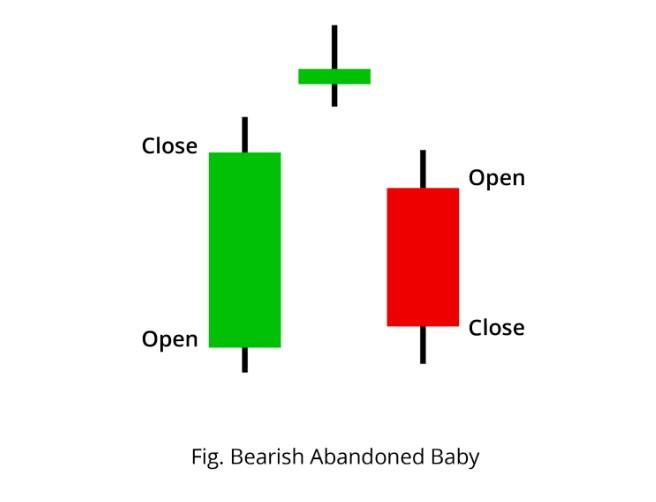
The Abandoned Baby pattern consists of three consecutive candles:
- Candle 1: A strong trend candle (bullish in an uptrend or bearish in a downtrend), reflecting dominant market momentum.
- Candle 2: A Doji candle that gaps away from the first candle, showing indecision and isolation from the prior trend.
- Candle 3: A strong candle in the opposite direction of the trend, which gaps away from the Doji and confirms the reversal.
Key Conditions for Formation
- The pattern must form after a clear and sustained trend (uptrend or downtrend).
- The second candle must be a Doji (very small or no body).
- There must be a gap between Candle 1 and Candle 2, and another gap between Candle 2 and Candle 3.
- The Doji must be completely isolated (no overlap with surrounding candles).
- The third candle must strongly confirm the reversal direction.
Detailed Explanation
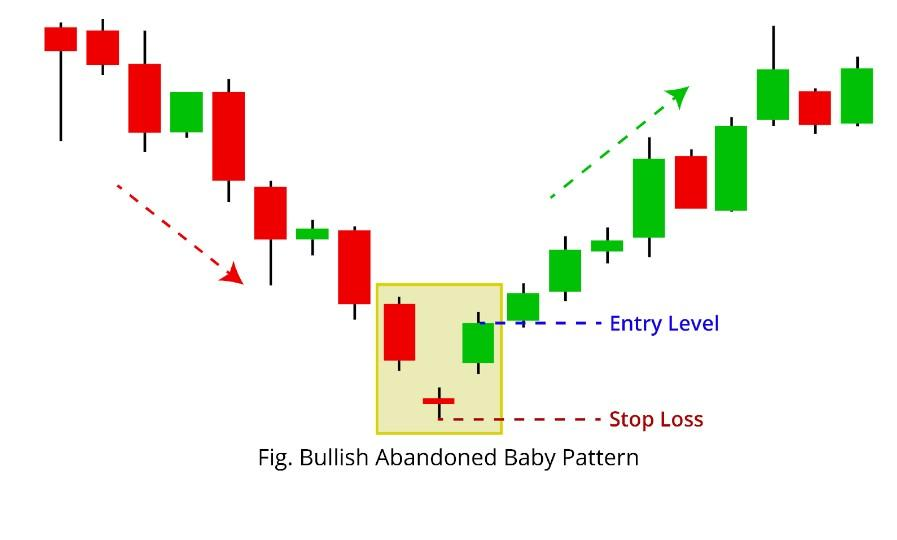
The Abandoned Baby pattern represents a complete shift in market control. After a strong trend (first candle), the market gaps and forms a Doji, indicating sudden indecision and a pause in momentum.
The key feature is the isolation of the Doji, which reflects a disconnect between prior and upcoming price action. The third candle then gaps in the opposite direction and moves strongly, confirming that control has shifted entirely from buyers to sellers (or vice versa).
This pattern is considered highly reliable because it reflects a sharp and decisive change in sentiment rather than gradual weakening.
- The double gap formation increases reliability.
- The Doji represents a transition point.
- Strong bullish confirmation validates reversal.
- Often marks the beginning of a new uptrend.
Market Psychology
Similarly, in a downtrend, sellers lose control and buyers step in aggressively, leading to a bullish reversal.
The psychology behind the Abandoned Baby pattern is based on sudden sentiment reversal:
- In an uptrend, buyers are initially in control (first candle).
- A gap-up followed by a Doji indicates hesitation and exhaustion.
- The next gap-down and bearish candle shows sellers taking full control.
- Buyers are trapped at higher levels, accelerating the reversal.
Trade Interpretation
- Entry: Traders typically enter after the close of the third candle, once reversal is confirmed.
- Confirmation: The gap and strong movement in the third candle act as confirmation.
- Stop Loss: Placed beyond the extreme of the pattern (above or below the Doji).
- Target: Targets are based on support/resistance levels or trend reversal strategies.
Timeframe Relevance (Algo Context)
In a 5-minute timeframe environment:
- The pattern forms over 3 candles (15 minutes total).
- It becomes active after the third candle closes.
- It remains valid for the next 1-2 candles.
- Quick confirmation is critical due to short-term price movements.
Role of Volume
Volume enhances the reliability of the pattern:
- Volume may decrease during the Doji (indecision phase).
- A spike in volume during the third candle confirms strong participation.
- Weak volume reduces reliability of the reversal.
Using Indicators for Confirmation
To improve reliability, traders combine the Abandoned Baby pattern with technical indicators:
- RSI: Overbought/oversold levels support reversal.
- MACD: Crossover or divergence confirms momentum shift.
- Volume: Increased volume strengthens confirmation.
When to Avoid
- In low liquidity markets where gaps are unreliable.
- When gaps are not clearly formed (overlapping candles).
- In sideways or choppy conditions.
- When the third candle is weak or lacks momentum.
Precautions
- Ensure both gaps are clearly visible before considering the pattern valid.
- Avoid trading without confirmation from the third candle.
- Combine with trend analysis and indicators for better accuracy.
- Be cautious in intraday charts where true gaps are rare.
Related Patterns
- Morning Star (bullish reversal)
- Evening Star (bearish reversal)
- Doji Star
- Island Reversal
Practical Insights
In algorithm-based detection systems:
- The pattern is identified using OHLC data with strict gap detection rules.
- Both gaps must be validated (no overlap conditions).
- The Doji must meet strict criteria (very small body).
- Signals are activated only after the third candle confirms direction.
- Duplicate signals are filtered within short intervals.
Example Scenario
Consider a stock in a strong uptrend where a bullish candle is followed by a gap-up Doji, showing indecision. The next candle opens with a gap-down and moves sharply lower. This indicates that buyers have lost control and sellers have taken over, creating a strong bearish reversal opportunity.
SUMMARY
- Pattern Type: Bullish Reversal
- Candles Required: 3
- Key Signal: Isolated Doji with double gap on both sides
- Best Use Case: After strong trends
- Confirmation Needed: Yes (third candle)
- Reliability: High when clear gaps and strong confirmation exist