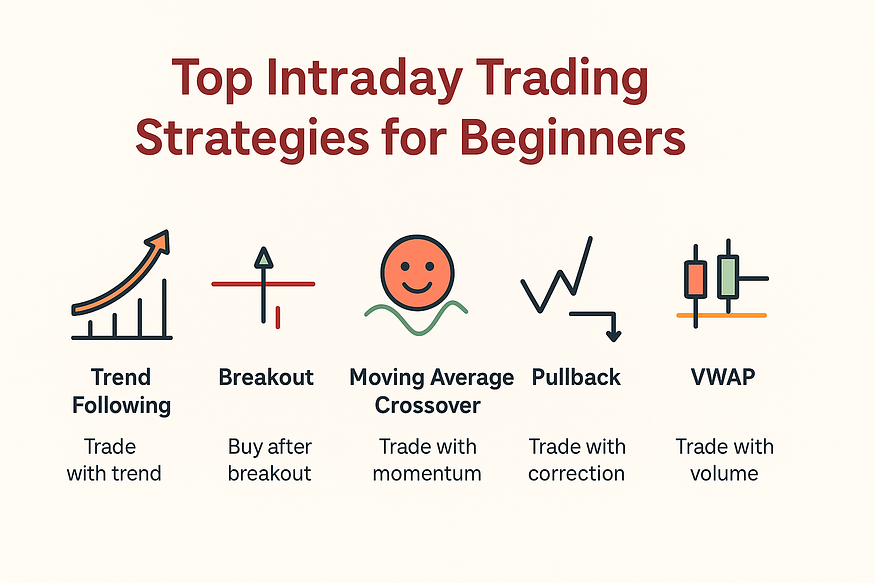
Intraday trading can feel fast, exciting, and sometimes confusing — especially when you’re just getting started. The good news is that you don’t need complicated formulas or advanced analysis to begin. With a few simple strategies, you can learn how the market behaves and make smarter decisions.

In this article, we’ll explore some of the most beginner-friendly intraday trading strategies, along with easy examples to understand how they work.
🔍 1. Trend Following Strategy
This is one of the most common and easiest strategies. Instead of predicting reversals, you simply trade in the direction of the trend.
📌 How to identify a trend:
- If price makes higher highs and higher lows → Uptrend
- If price makes lower highs and lower lows → Downtrend
📍 How to trade:
- In an uptrend → Look for buy opportunities
- In a downtrend → Look for short-sell opportunities
👉 Example:
If a stock moves from ₹150 → ₹160 → ₹168 and dips to ₹164 but continues rising, you’re in an uptrend — meaning buying makes sense.
🚀 2. Breakout Strategy
A breakout happens when price moves above a strong resistance or below a strong support level.
- 📌Resistance: Price level where the stock usually stops rising
- 📌Support: Price level where the stock usually stops falling
📍 How to trade:
- If price breaks above resistance with strong volume → Buy
- If price breaks below support with strong volume → Sell
👉 Example:
A stock is stuck between ₹95 (support) and ₹105 (resistance). If it jumps to ₹108 with high volume, it signals a buy breakout trade.
📈 3. Moving Average Crossover Strategy
Moving averages help smooth out price movement and show direction.
The two most used for intraday are:
- 9-period EMA
- 21-period EMA
📍 Rules:
- When 9 EMA crosses above 21 EMA → Buy signal
- When 9 EMA crosses below 21 EMA → Sell signal
👉 Example:
If 9 EMA moves above 21 EMA at ₹220, you buy. If later it crosses below at ₹230, you exit — locking profit.
🎯 4. Pullback Strategy
Markets do not move in a straight line. Even in a strong trend, there are small corrections (pullbacks). This strategy takes advantage of those corrections.
📍 How to trade:
- Identify a strong trend
- Wait for a small pullback
- Enter trade when the trend resumes
👉 Example:
A stock climbs from ₹300 → ₹340, drops slightly to ₹330, then begins rising again — that bounce point is your entry.
🧭 5. VWAP Strategy
VWAP (Volume Weighted Average Price) is one of the most popular tools for intraday traders.
📍 How to use VWAP:
- If price stays above VWAP → Market is bullish → Look for buys
- If price stays below VWAP → Market is bearish → Look for sells
👉 Example:
A stock stays above VWAP after 11 AM with stable volume — meaning buyers are strong and a long trade is safer.
🛑 Bonus Tip: Avoid Trading in the First 10–15 Minutes
The market usually opens with volatility due to overnight news and pending orders. Beginners should avoid rushing into early trades and wait for trends to settle.
🧠 Common Mistakes Beginners Make
- 🚫 Entering trades without a plan
- 🚫 Over-trading out of excitement or fear
- 🚫 Ignoring stop-loss
- 🚫 Trading based only on tips
Successful intraday trading is not about guessing — it’s about planning and following rules.
⭐ Final Thoughts
Intraday trading is a skill, and like any skill, you improve with practice. These strategies give you a strong foundation — but the real power comes from discipline, patience, and reviewing your trades.
Start simple, test strategies one at a time, and trade small until confident.