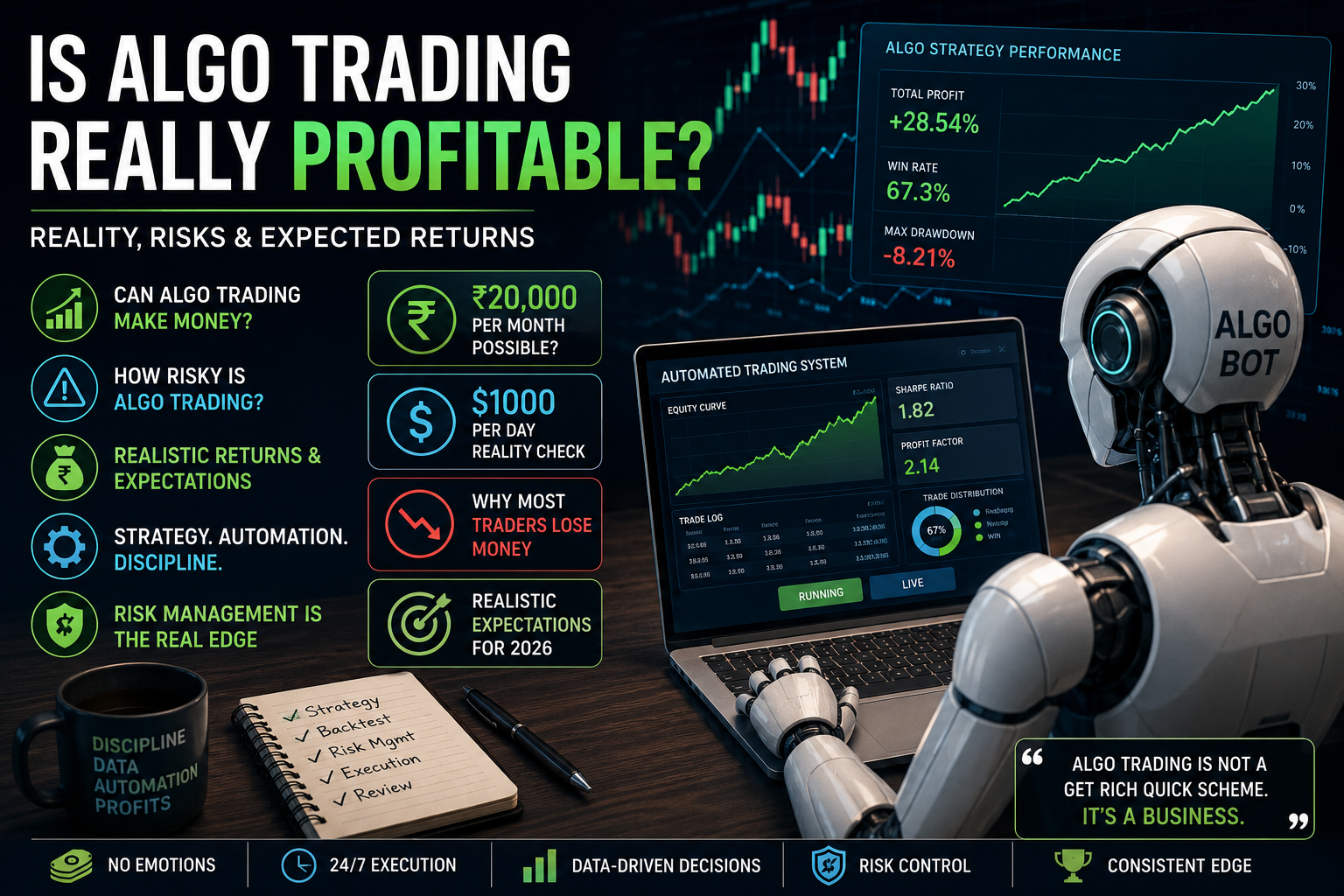
Is Algo Trading Really Profitable?
Scroll through any trading forum or YouTube comment section and you'll find two completely opposite stories about algo trading. One camp swears it's the only way to trade — a disciplined, emotion-free system that prints money while you sleep. The other camp says it's a fast way to lose your capital faster than manual trading ever could. Both stories are true, depending on who is running the algorithm, how it was built, and how much capital and risk control stands behind it.
This guide sets aside the hype in both directions and looks at what the actual data — most of it from SEBI's own studies of Indian retail traders — says about whether algo trading is profitable, how risky it really is, what income levels are realistic, and why the majority of people who try it still end up losing money.
Before getting into the numbers, it's worth being clear about what "profitable" actually means in this context. A strategy can be profitable on average over a long stretch of time while still losing money in most individual weeks or months — that's simply how probability-based trading works. A strategy can also look highly profitable in a backtest and still lose money the moment it goes live, because past price data and live market conditions are never perfectly identical. Keeping this distinction in mind is essential to reading the rest of this article correctly.
Can Algo Trading Make Money?
Yes, algo trading can make money — but the honest answer stops there unless you add some important context. Algorithms themselves have no inherent edge. A trading algorithm is simply a tool that executes a strategy exactly as it's coded, faster and more consistently than a human clicking buttons. If the underlying strategy has a genuine statistical edge — meaning it wins more, or wins bigger, than it loses over a large enough number of trades — automating it can make that edge more consistent and remove the emotional mistakes that erode manual trading performance. If the underlying strategy has no real edge, automating it just means you lose money faster and with less effort.
The clearest evidence that algo trading can be profitable comes from looking at who is actually making money in Indian markets. SEBI's own research has repeatedly found that institutional players — foreign portfolio investors and proprietary trading desks — are consistently profitable in the same derivatives segment where retail traders are consistently losing money, and that the overwhelming majority of institutional profit is generated through algorithmic execution. In other words, algo trading is clearly capable of producing real, sustained profits — it's just that historically, the players doing it well have been well-capitalised institutions with dedicated quant teams, not individual retail traders running a strategy they downloaded off a Telegram channel.
What's changed is accessibility. SEBI's 2025-2026 regulatory framework, broker APIs, and no-code strategy platforms have brought institutional-style automation within reach of retail traders for the first time. That doesn't automatically make retail algo traders profitable — it just means the tools institutions used to have exclusively are no longer the only thing separating a retail trader from a professional one. Skill, risk management, and realistic expectations still make the difference.
It also helps to understand which kinds of strategies tend to hold up better in the real world versus which ones tend to look good only in hindsight:
- Strategies more likely to have a real, durable edge: systematic risk-managed approaches with a clear statistical or structural rationale — for example, exploiting a well-understood volatility pattern, a documented seasonal effect, or a disciplined trend-following system tested across multiple market cycles and asset classes.
- Strategies more likely to be an illusion: anything reverse-engineered from a single stock's or index's recent price history with dozens of tunable parameters, anything that only "works" over a short and unusually favourable backtest window, and anything sold with promises of a fixed win rate above roughly 80-90%, which is a level almost no legitimate strategy sustains over the long run.
How Risky is Algo Trading?
Algo trading carries the same underlying market risk as any other form of trading, plus a set of additional operational risks specific to automation. You can still lose your entire capital, and an automated strategy with a flawed rule set or poor risk controls can lose money faster than a human trader would, simply because it doesn't hesitate, doubt itself, or stop to reconsider before placing the next order.
Broadly, algo trading risk falls into three buckets:
- Market risk — the same risk every trader faces: prices can move against your position regardless of whether a human or a machine placed the order.
- Strategy risk — the risk that the underlying logic simply isn't as good as it looked in a backtest. Many retail strategies are curve-fitted to historical data and fall apart the moment market conditions shift.
- Operational risk — bugs in code, API outages, internet disconnections, data feed errors, or a missing stop-loss check, any of which can cause an algorithm to keep trading when it should have stopped, or fail to exit a position that's losing money.
Because an algorithm can place dozens or hundreds of orders in the time it takes a human to place one, poorly built systems can compound losses extremely quickly. This is exactly why SEBI's 2026 framework requires brokers to run mandatory pre-trade risk checks and automated exposure limits on every algorithmic order — the regulatory response to operational risk becoming a genuine, recurring problem in the market.
| Risk Type | What It Looks Like | How It's Typically Managed |
|---|---|---|
| Market risk | Price moves against your position | Position sizing, stop-losses, diversification |
| Strategy risk | Backtest performance doesn't hold up live | Out-of-sample testing, forward/paper testing, ongoing review |
| Operational risk | Bugs, API outages, missed stop-loss execution | Broker-side risk checks, kill switches, redundant monitoring |
| Leverage risk | Losses magnified by oversized derivative positions | Conservative position sizing relative to capital, exposure limits |
| Provider risk | Unregistered "black box" strategy with no accountability | Using only registered brokers and empanelled algo providers |
Can You Earn ₹20,000 Per Month?
It's technically possible, but it depends heavily on your capital base, your strategy's real edge, and your risk tolerance — not on the fact that the trading is automated. To put ₹20,000 a month in perspective: that works out to roughly ₹2.4 lakh a year. If you're trying to generate that purely from trading returns rather than from a large capital base compounding slowly, you'd typically need either a meaningful amount of capital generating modest, realistic returns, or a small amount of capital generating an aggressive return that comes with proportionally aggressive risk.
For context: a strategy generating a genuinely strong 20-25% annualised return — a level that would be considered excellent even by professional standards — would need roughly ₹10-12 lakh in deployed capital to produce ₹20,000 a month on average. A smaller account chasing the same monthly figure would need a much higher return rate, which almost always means taking on much higher risk, higher position sizes relative to capital, and a much greater chance of a losing month wiping out several winning ones.
The honest framing is this: ₹20,000 a month from algo trading is achievable for someone with sufficient capital, a strategy with a real, tested edge, and disciplined risk management applied consistently over time. It is not a realistic starting expectation for someone deploying a small account on a strategy they haven't rigorously tested, regardless of how automated or "AI-powered" the platform claims to be.
Can You Make ₹1 Lakh Per Day?
This is where hype and reality diverge the most. ₹1,00,000 a day, if achieved consistently across roughly 250 trading days a year, works out to about ₹2.5 crore a year — a return profile that would place an individual trader in the same league as some of the most successful proprietary trading desks and hedge funds in the country. Institutions with years of infrastructure investment, dedicated research teams, and access to co-location servers struggle to sustain returns at that level consistently. It is not a realistic, repeatable target for an individual retail algo trader, regardless of platform, capital, or strategy.
That doesn't mean no single day could ever produce ₹1 lakh in profit — a large enough account, a highly volatile day, and a favourable move could absolutely produce that on occasion. The problem is treating it as a consistent, dependable income target. Any platform, course, or "signal provider" marketing guaranteed daily rupee-figure returns at that scale to retail traders should be treated as a serious red flag rather than an achievable benchmark — this is precisely the kind of unrealistic promise SEBI's crackdown on unregistered algo providers and "black box" strategy sellers was designed to address.
A simple worked example helps illustrate why these income targets are so hard to sustain. Imagine two hypothetical traders, each running an automated intraday strategy with a genuinely solid (by realistic standards) 55% win rate and a risk-to-reward ratio of 1:1.5 per trade:
- Trader A risks ₹2,000 per trade on a ₹2 lakh account and takes 4 trades a day. Over a month of roughly 20 trading days, this strategy might realistically net somewhere in the range of ₹15,000-₹25,000 — a good result, but arrived at through many small wins and losses, not one dramatic streak.
- Trader B tries to hit a fixed ₹1-lakh-a-day target on the same account size by increasing position size five-fold. The strategy's edge hasn't changed, but the swings now happen on positions five times larger — meaning a single bad day, or a short losing streak (which any strategy will eventually have), can erase weeks of gains or breach the account's risk limits entirely.
The strategy is identical in both cases. The only thing that changed is position size relative to the account — which is exactly why "how much you risk per trade" tends to matter more for long-term survival than which specific strategy you're running.
Why Most Traders Lose Money
This is where the data gets genuinely sobering. SEBI's most recent study, covering FY25, found that 91% of individual traders in the equity derivatives segment lost money, with collective net losses widening 41% year-on-year to roughly ₹1.05 lakh crore. An earlier SEBI study covering FY22 to FY24 found a similar pattern — around 93% of retail traders lost money over that period, with an average loss of roughly ₹2 lakh per trader, and the bottom 3.5% of loss-makers losing an average of ₹28 lakh each. Automation does not automatically fix this pattern, and in many cases makes it worse. Here's why.
| SEBI Study Period | % of Retail Traders Who Lost Money | Key Figure |
|---|---|---|
| FY19–FY22 | ~89% | Average loss of ₹1.1 lakh per trader |
| FY22–FY24 | ~93% | Collective losses over ₹1.8 lakh crore; average loss ~₹2 lakh |
| FY25 | 91% | Net losses widened 41% YoY to ~₹1.05 lakh crore |
The pattern across every study period is remarkably consistent: somewhere between 89% and 93% of individual F&O traders lose money, regardless of the specific years measured. This consistency matters, because it shows the problem isn't a one-off bad year or a temporary market condition — it's a structural feature of how most retail traders approach derivatives trading, with or without automation.
- Most retail strategies aren't real edges — they're curve-fitted backtests. It's extremely easy to build a strategy that looks fantastic on historical data by unintentionally tuning its parameters to fit exactly what already happened. This is called overfitting, and it's one of the most common reasons a strategy that shows a beautiful backtest curve falls apart the moment it trades on new, live data.
- Automation removes hesitation, not risk. A human trader might pause before doubling down on a losing position. A poorly designed algorithm won't — it will keep executing its rules exactly as written, for better or worse, which means a flawed strategy can lose money with mechanical consistency.
- Retail traders are competing against genuinely faster, better-capitalised players. SEBI's data shows that the vast majority of institutional profit in Indian derivatives — well over 90% of both FPI and proprietary trading profits — comes from algorithmic execution. Retail algo traders aren't automating into an empty room; they're automating into a market where institutions already have a significant structural and technological edge.
- Position sizing and leverage amplify mistakes. Many retail traders, especially in derivatives, use leverage that magnifies both gains and losses. An automated strategy trading oversized positions relative to account capital can turn a string of small, normal losing trades into an account-ending drawdown.
- Unregulated "black box" strategy sellers. Before SEBI's 2025-2026 framework, a wave of unregistered platforms sold retail traders access to opaque algorithms with no disclosed backtest data, no risk transparency, and no accountability when the strategy failed. Many retail losses over the past few years trace directly back to this kind of unverified, unregistered product.
- Chasing income targets instead of following a process. Traders who set a fixed daily or monthly income goal — rather than following a tested, risk-managed process — tend to increase position sizes or override their own risk rules when a strategy underperforms, which is one of the most common ways a manageable drawdown turns into a catastrophic one.
Realistic Expectations
Given the data above, what does a realistic outlook for a retail algo trader in India actually look like?
- Most traders should expect to lose money, at least initially. The base rate across SEBI's studies has consistently sat between 89% and 93% of retail derivatives traders losing money over multi-year periods. Algo trading changes how orders are placed — it doesn't change these base rates on its own.
- A genuinely profitable strategy, if you find or build one, is more likely to produce modest, compounding returns than dramatic daily windfalls. Annualised returns in the high teens to mid-20s percent range would be considered strong by professional standards — treat any strategy or provider promising dramatically more than that with real scepticism.
- Capital matters more than most beginners expect. A strategy with a real, modest edge needs a meaningful capital base to produce meaningful rupee returns. Trying to compensate for a small account with aggressive leverage or oversized positions is one of the fastest routes to the loss statistics above.
- Time and testing matter as much as the strategy itself. Backtesting, forward-testing (paper trading on live data before risking real money), and an honest post-launch review process separate traders who improve over time from traders who repeat the same mistakes with more automation.
- Regulation reduces one risk, not all of them. SEBI's framework makes it much harder for outright fraudulent or unregistered "black box" providers to operate, and it forces brokers to apply baseline risk controls. It does nothing to guarantee that any individual strategy — yours or a provider's — actually has a statistical edge. That part is still entirely on the trader.
The realistic takeaway is that algo trading is a tool, not a guarantee. It can meaningfully improve the execution and discipline of a strategy that already has a genuine edge, and it can just as easily accelerate the losses of a strategy that doesn't. Anyone evaluating a platform, course, or provider promising fixed monthly income or eye-catching daily rupee figures should measure those claims against SEBI's own data on how the average retail trader actually performs — not against the marketing.
How to Improve Your Odds
None of the data above means algo trading is a lost cause for retail investors — it means the traders who do well tend to treat it as a discipline rather than a shortcut. A few habits consistently separate the minority who stay profitable from the majority who don't:
- Test out-of-sample, not just in-sample. Build and tune your strategy on one chunk of historical data, then test it, unchanged, on a completely different period it has never seen. A strategy that only performs well on the data it was built on is a warning sign, not a green light.
- Paper trade before going live. Running a strategy on live market data without real money exposes execution issues, latency problems, and behavioural quirks that a backtest alone won't reveal.
- Size positions for survival, not for a target income. Decide your maximum risk per trade and per day based on your account size and your strategy's historical drawdowns — not based on how much money you'd like to make this month.
- Keep a trading journal, even for automated strategies. Reviewing what actually happened, trade by trade, is how you catch strategy decay — the gradual breakdown of a strategy's edge as market conditions evolve — before it erases months of gains.
- Treat every regulatory safeguard as a floor, not a ceiling. Using a registered broker and an empanelled algo provider protects you from fraud and unaccountable "black box" products, but it says nothing about whether your specific strategy has a real edge. That verification is still your responsibility.
Algo Trading vs Manual Trading: Does Automation Change the Odds?
A fair question underneath all of this is whether automating a strategy actually changes your odds of profitability compared to trading the same idea manually. The honest answer is that automation is a multiplier, not a fix — it amplifies whatever is already true about your underlying strategy and risk discipline.
| Factor | Manual Trading | Algo Trading |
|---|---|---|
| Execution speed | Limited by human reaction time | Near-instant, consistent execution |
| Emotional interference | High — fear and greed affect decisions | Low — rules are followed exactly as coded |
| Consistency | Varies day to day, trader to trader | Highly consistent, for better or worse |
| Ability to catch mistakes mid-trade | A trader can pause and reconsider | Executes as coded unless a risk check intervenes |
| Scalability | Limited to what one person can monitor | Can monitor and trade many instruments simultaneously |
| Underlying edge required | Needed for long-term profitability | Equally needed — automation doesn't create an edge |
The takeaway is straightforward: automation is genuinely good at removing emotional decision-making and executing a tested plan with discipline. It is equally good at executing a flawed plan with the same discipline, straight into a drawdown. Whether algo trading improves your odds compared to manual trading depends almost entirely on whether the strategy underneath it already has a real, tested edge.
Frequently Asked Questions
Can I earn ₹20K monthly?
It's possible, but it depends on your capital, your strategy's real edge, and disciplined risk management — not on automation alone. Realistically, ₹20,000 a month tends to require either substantial deployed capital at moderate, sustainable returns, or a much smaller account taking on considerably higher risk, which comes with a much greater chance of loss.
Can I lose money?
Yes. Algo trading does not eliminate market risk, and SEBI's own studies show that roughly 9 in 10 retail derivatives traders lose money over multi-year periods. Automation can make a genuinely good strategy more consistent, but it can just as easily make a flawed strategy lose money faster.
Is algo trading risky?
Yes. Alongside normal market risk, algo trading adds strategy risk (a backtest that doesn't hold up in live markets) and operational risk (bugs, outages, or missing risk checks). SEBI's 2026 framework requires brokers to apply mandatory risk checks to automated orders specifically because these risks are real and had been causing problems.
How much capital is needed?
There's no fixed minimum, but meaningful rupee returns require meaningful capital — a strategy generating a strong, realistic 20-25% annual return needs roughly ₹10-12 lakh deployed to produce around ₹20,000-25,000 a month on average. Smaller accounts can still trade algorithmically, but should expect proportionally smaller returns and should be especially cautious about using leverage to compensate.
Related Reads
This article is for educational purposes only and does not constitute investment advice. Past performance and backtested results do not guarantee future returns. Please assess your own risk tolerance and consult a registered financial advisor before trading.