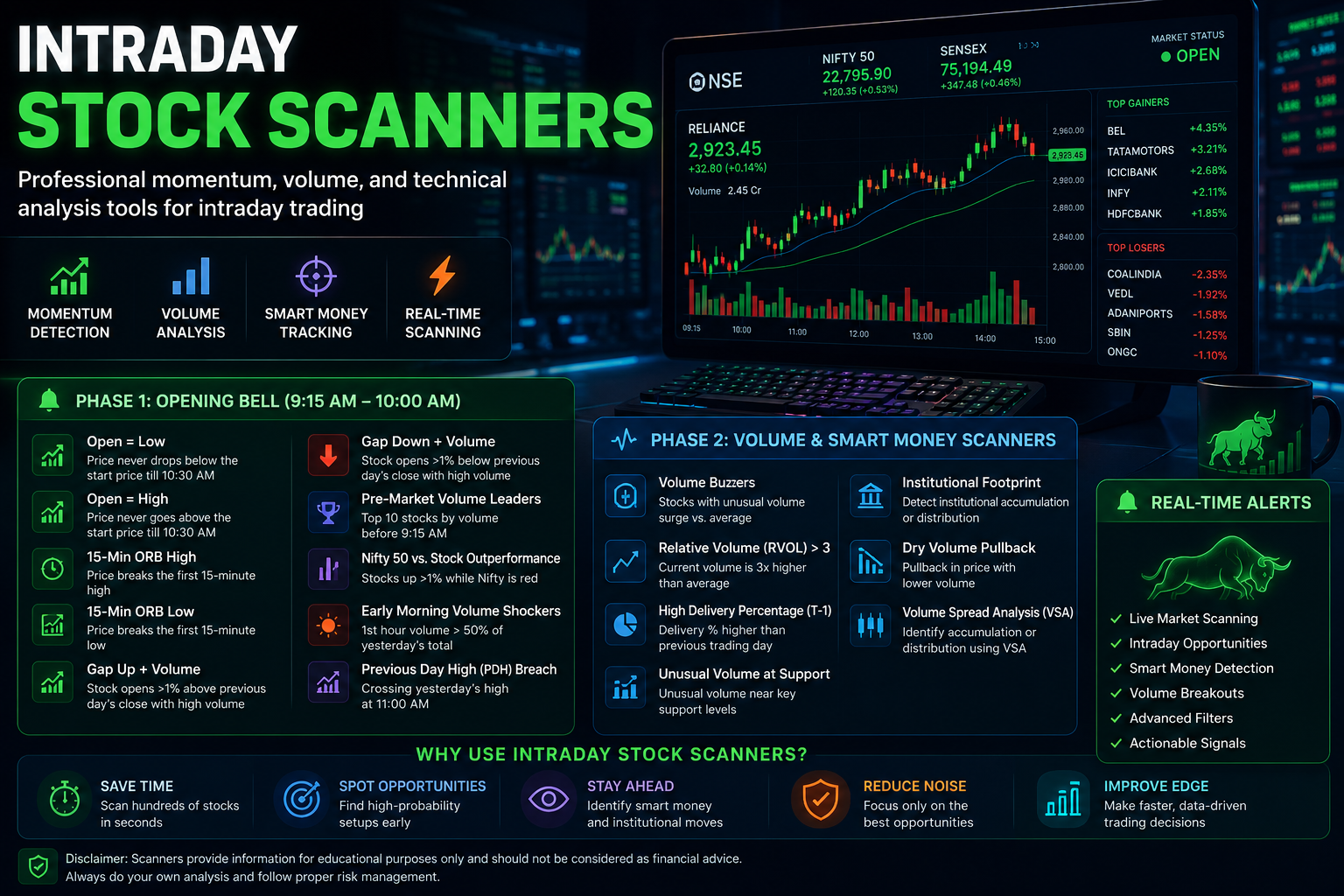
How Intraday Filters Help Traders Find Opportunities
Intraday filters are designed to help traders quickly identify stocks exhibiting significant market activity during the trading session. Rather than manually monitoring hundreds of charts, traders can use automated filters to discover stocks that meet specific price, volume, momentum, or market participation criteria.
These filters continuously analyze real-time market data and highlight stocks showing unusual behavior, allowing traders to focus on opportunities with greater potential for movement and liquidity.
Why Use Intraday Filters?
The stock market generates massive amounts of data every second. Intraday filters simplify this process by narrowing down the market to a manageable list of stocks that deserve attention.
Instead of spending valuable trading hours searching for setups, traders can rely on filters to instantly identify stocks that align with their trading approach and market conditions.
Key Benefits of Intraday Filters
- Monitor large numbers of stocks simultaneously.
- Reduce manual chart screening and research time.
- Identify momentum-driven opportunities faster.
- Track unusual price and volume activity in real time.
- Discover stocks attracting significant market participation.
- Highlight potential breakout and breakdown candidates.
- Improve trading efficiency and workflow.
- Stay focused on high-activity stocks throughout the session.
- Reduce emotional decision-making through rule-based filtering.
- Adapt quickly to changing market conditions.
- Improve market awareness without information overload.
- Support both momentum and trend-following trading styles.
- Help traders prioritize opportunities based on predefined conditions.
How Traders Can Use Intraday Filters
Intraday filters can be used at different stages of the trading session:
- Market Open: Identify stocks showing early strength, weakness, or abnormal activity.
- Mid-Session: Monitor developing trends, volume expansion, and continuation setups.
- Late Session: Track stocks maintaining momentum or preparing for end-of-day moves.
- Market Review: Analyze filtered results to understand market behavior and improve future trading decisions.
Many traders combine multiple filters to create a structured watchlist that aligns with their risk tolerance and trading strategy.
Improving Trading Efficiency
One of the biggest challenges in intraday trading is information overload. With thousands of stocks actively trading, identifying meaningful opportunities manually can be difficult and time-consuming.
Intraday filters solve this problem by automatically narrowing the market to stocks that meet specific criteria, allowing traders to focus on analysis and execution rather than searching for opportunities.
This structured approach helps traders remain disciplined, consistent, and responsive to changing market conditions.
Risk Management Still Comes First
While intraday filters can significantly improve stock selection, they do not guarantee profitable trades. Every trading decision should be supported by proper analysis, risk management, and trading discipline.
- Use predefined stop-loss levels.
- Follow proper position sizing rules.
- Avoid overtrading based solely on scanner results.
- Consider overall market conditions before entering trades.
- Validate opportunities using technical or price-action analysis.
- Maintain a consistent risk-to-reward approach.
Conclusion
Intraday filters help traders cut through market noise and focus on stocks displaying meaningful price action, volume activity, and market participation. By automating the stock discovery process, traders can spend less time searching and more time analyzing high-potential opportunities.
Whether used for momentum trading, breakout trading, trend-following setups, or volume-based analysis, intraday filters provide a systematic approach to finding opportunities in fast-moving markets.
When combined with sound risk management, disciplined execution, and a well-defined trading plan, intraday filters can become a valuable tool for improving trading efficiency, market awareness, and decision-making throughout the trading day.