How AI Is Changing the Way Traders Analyse Stocks
Stock analysis has never been short of data. The real challenge is making sense of it before the opportunity passes.
A trader might spend hours reviewing charts, technical indicators, financial statements, sector performance, corporate announcements, and market trends. Repeat that process across dozens of stocks, and research quickly becomes time-consuming.
This is where AI can help.
Not by predicting every market move, but by helping traders process information faster, connect different signals, and identify what deserves closer attention.
Working across software engineering, fintech, and algorithmic trading has made one thing clear to me: the real value of AI in stock analysis lies in how well it connects data, context, and reasoning.
Where AI Makes a Difference
AI can assist with several parts of the stock analysis process.
- Fundamental analysis: Summarise financial results, evaluate profitability, compare valuation metrics, and highlight potential concerns such as elevated debt or slowing earnings growth.
- Technical analysis: Interpret trend direction, moving averages, RSI, MACD, VWAP, price action, and candlestick patterns together rather than viewing each indicator in isolation.
- Market context: Bring sector performance, corporate announcements, relevant news, and broader market conditions into the analysis.
- Risk assessment: Highlight conflicting signals, weak momentum, elevated volatility, and other factors that could challenge a trading setup.
The advantage is not simply getting an AI-generated report. It's reducing the time spent collecting and organising information so traders can focus on evaluating the evidence.
Why Multi-Agent AI Is Worth Exploring
A single AI prompt may be asked to analyse fundamentals, technical indicators, market conditions, and risks all at once. For complex tasks, a more structured approach can be useful.
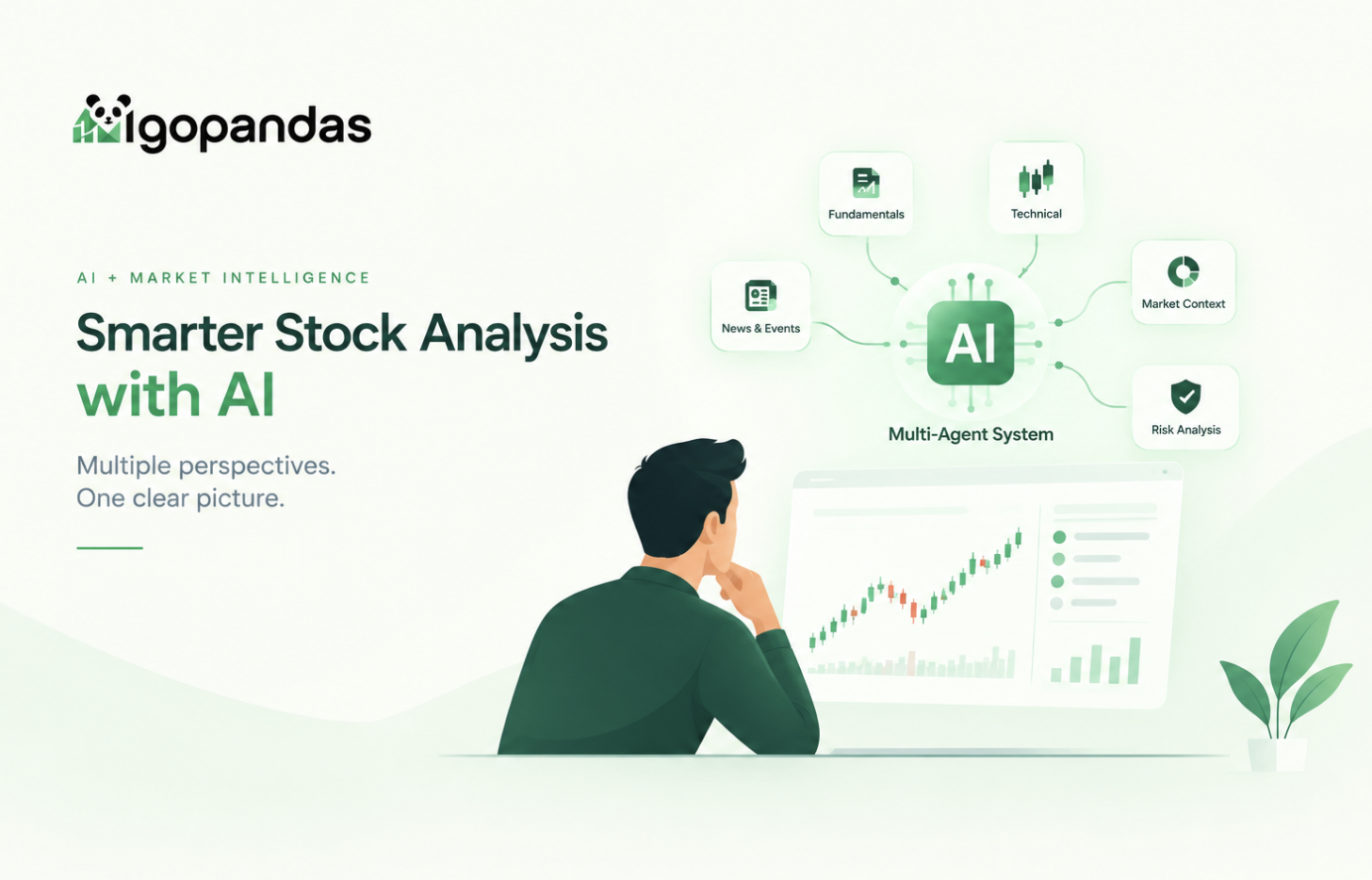
A multi-agent system divides the work into specialised responsibilities. One agent can analyse fundamentals, another can evaluate technical conditions, and others can examine market context and risk. A final component combines their findings into a single, structured assessment.
This approach can make the analysis easier to organise and review, provided each component has clear responsibilities and access to reliable data.
More agents do not automatically mean better results. Poor data, duplicated reasoning, and unsupported conclusions can still undermine the output. The system needs validation, not just a sophisticated architecture.
How Traders Can Use AI More Effectively
You don't need a complex AI platform to start.
- Filter first, analyse second. Use screeners to narrow hundreds of stocks to a manageable watchlist, then use AI to help interpret the results.
- Ask for evidence on both sides. Don't just ask why a stock looks bullish. Ask what could invalidate that view.
- Combine signals with context. A bullish technical setup can look very different when the sector is weakening or company fundamentals are deteriorating.
- Verify the output. Check the underlying data, timestamps, calculations, and assumptions. A confident AI response is not proof that the analysis is correct.
AI can accelerate research, but it cannot remove market uncertainty. A good-looking report does not guarantee a profitable trade.
What We're Building at AlgoPandas
At AlgoPandas, we're developing an AI-powered stock analysis system using a multi-agent approach.
The goal is to bring fundamental analysis, technical conditions, price action, candlestick patterns, relevant market context, and risk assessment together in one place.
Instead of switching between multiple tools to build a picture of a stock, users will be able to generate a structured analysis in a single workflow.
We're currently testing and refining the system to improve the consistency and usefulness of its findings. The focus is on connecting reliable data with specialised analysis and presenting the results in a way traders and investors can actually use.
The Real Opportunity
AI doesn't eliminate the need for market knowledge, discipline, or risk management. Used properly, it can help traders spend less time gathering information and more time evaluating decisions.
The real question isn't whether AI can analyse a stock. It's whether it can help you understand the available evidence faster, spot what you might have missed, and make a better-informed decision.
That's where I believe AI can make a practical difference in stock analysis.
Disclaimer: This article is for educational and informational purposes only. It does not constitute investment advice or a recommendation to buy, sell, or hold any security. Always conduct your own research before making investment decisions.