Good Trading Systems Don't Just Find Signals. They Make Trading Decisions Repeatable
When a stock suddenly moves 5%, the first question most traders ask is simple: “Should I buy it?”
But experienced traders know that a price move by itself doesn't tell the whole story.
Before making a decision, you may want to know whether the stock's sector is also gaining strength, whether volume is confirming the move, whether the broader market is supportive, whether technical indicators are aligned, and whether a fundamental or news event is driving the price.
This is where a good trading system becomes much more than a tool that generates buy and sell signals.
A well-designed system connects multiple pieces of market information and turns them into a repeatable decision-making process.
The real journey is:
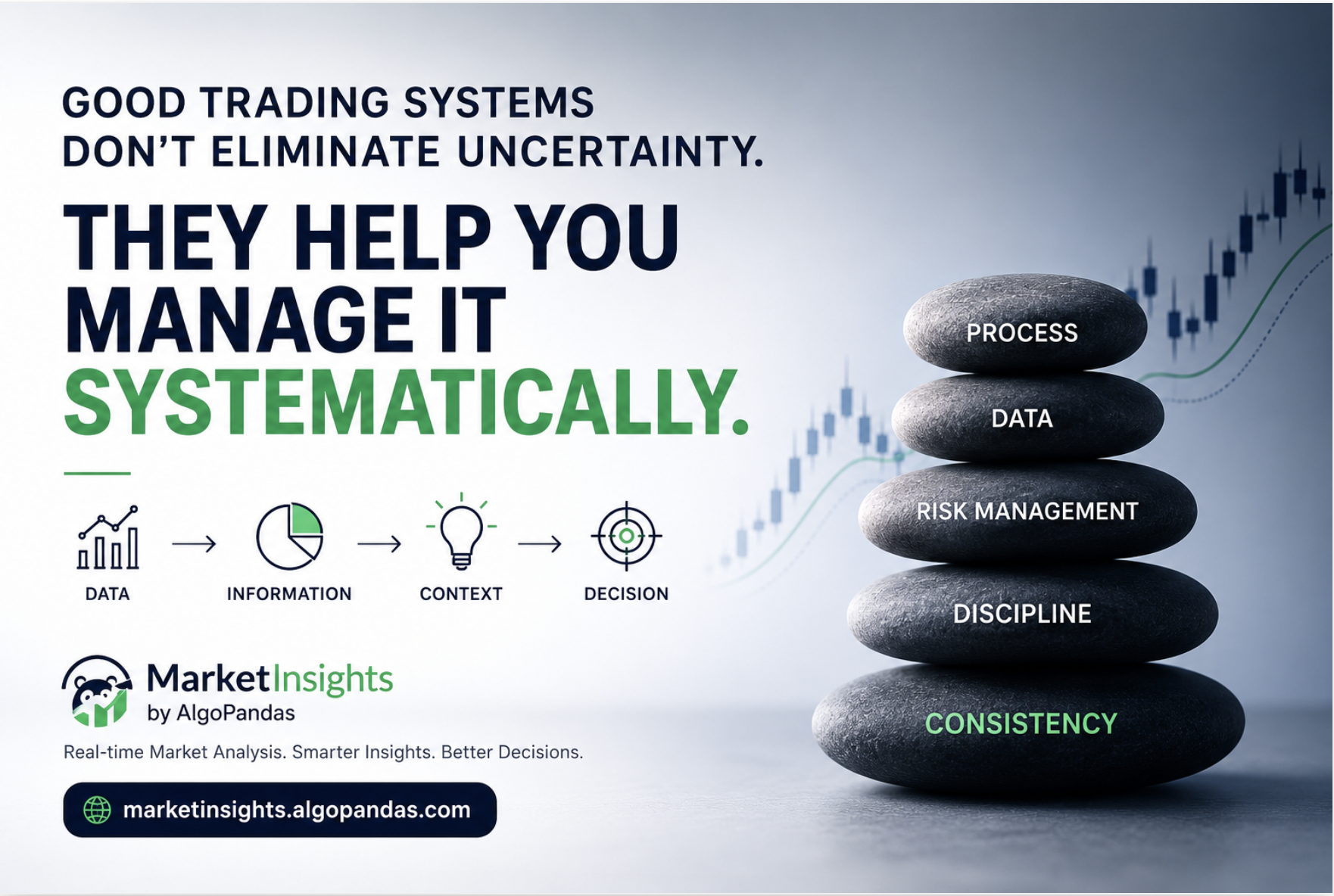
Raw Data → Information → Context → Decision
And this is one of the principles behind building MarketInsights by AlgoPandas — bringing different layers of market information together so traders can analyze opportunities with greater consistency.
Why a Trading Signal Alone Isn't Enough
Imagine a stock is trading 4% higher than the previous day.
At first glance, it looks bullish.
But what if the entire market is up 3%?
What if the stock's sector is up 5%?
What if trading volume is below average?
What if the stock is approaching a major resistance level?
What if the move happened because of a temporary news event?
The same 4% price increase can mean very different things depending on the surrounding context.
This is why a strong trading system shouldn't look at only one indicator or one price movement.
It should attempt to answer a broader question:
“Is this move meaningful enough to deserve attention?”
From Raw Market Data to Useful Information
Financial markets generate enormous amounts of data every second.
Price, volume, open interest, technical indicators, sector performance, market breadth, fundamentals, news and historical patterns can all provide useful information.
But raw data by itself isn't necessarily useful.
The real challenge is transforming that data into information that can support a decision.
For example, instead of simply saying:
“Stock XYZ is up 5%.”
A more useful system might identify:
- The stock is outperforming its sector.
- The sector is outperforming the broader market.
- Trading volume is significantly above its recent average.
- Momentum indicators are supporting the move.
- The stock has crossed an important technical level.
- The broader market trend is supportive.
Now the trader has context instead of just a number.
The Importance of Market Context
A stock rarely moves in complete isolation.
Sector movement, market direction and broader sentiment can influence how meaningful an individual stock move really is.
Consider two stocks that both gain 5% on the same day.
The first stock belongs to a sector that is also gaining strongly, while the second stock is rising despite weakness across its sector.
Those two situations may represent very different market conditions.
A good trading platform should therefore help traders look beyond individual stocks and understand the environment surrounding them.
This is why combining stock-level analysis, sector analysis and broader market information can provide a much richer picture than looking at a single chart.
Volume Can Help Separate Strength From Noise
Price movement tells us what happened.
Volume can provide additional context about the participation behind that movement.
A stock moving higher with unusually strong volume may deserve more attention than a similar price move occurring with weak participation.
Of course, high volume doesn't automatically mean that a stock will continue rising.
It simply provides another piece of information that can be evaluated alongside price action, momentum, market conditions and other factors.
This is the difference between using volume as a standalone signal and using it as part of a broader decision-making framework.
Technical Indicators Should Work Together
Trading systems often use indicators such as RSI, moving averages, MACD, VWAP, ADX and other technical measurements.
But adding more indicators doesn't automatically create a better strategy.
The objective should be to use indicators for specific purposes.
- Momentum indicators can help identify strength or weakness.
- Moving averages can help understand trend direction.
- VWAP can provide an intraday reference for price relative to traded volume.
- Volume analysis can help evaluate participation.
- ADX can help evaluate trend strength.
The important part is how these signals interact.
A system that simply generates a trade whenever one indicator turns bullish may produce many signals.
A system that evaluates several relevant conditions can potentially filter out some of the weaker situations.
The goal isn't to create the maximum number of signals.
The goal is to identify higher-quality opportunities through a defined process.
Automation Brings Consistency
One of the biggest advantages of automation isn't that an algorithm can predict the future.
It can't.
Markets remain uncertain, and no system can guarantee that every trade will be profitable.
The real advantage is consistency.
Imagine manually scanning hundreds of stocks every morning.
One day you might analyze 20 stocks.
The next day you might analyze 50.
You might forget to check volume.
You might ignore a condition because you're in a hurry.
Or you might change your decision after seeing a sudden price movement.
A properly designed automated system can apply the same defined process repeatedly.
Collect → Analyze → Filter → Identify → Monitor
That repeatability is one of the biggest engineering advantages of automation.
Repeatability Makes a Strategy Measurable
There is another important advantage to a systematic approach.
You can measure it.
If the same rules are applied consistently, you can analyze the results and ask meaningful questions:
- How often does the strategy generate signals?
- Which market conditions produce the best results?
- Where does the strategy fail?
- How large are the drawdowns?
- Which filters improve signal quality?
- Does the strategy behave differently across sectors?
- Does performance change during different market regimes?
Without a defined process, these questions become much harder to answer.
With a systematic process, every signal becomes another data point that can be evaluated.
Good Trading Systems Are Built Around Process
A common mistake is to think that the most important part of a trading system is the entry signal.
In reality, a complete system needs much more than that.
| Component | Purpose |
|---|---|
| Market Data | Collect accurate and timely information. |
| Market Context | Understand broader market and sector conditions. |
| Technical Analysis | Evaluate momentum, trend, volatility and price structure. |
| Screening | Filter a large universe of stocks into relevant opportunities. |
| Signal Generation | Identify situations that satisfy predefined conditions. |
| Risk Management | Define how positions should be managed when conditions change. |
| Monitoring | Continue evaluating the opportunity after the initial signal. |
| Analytics | Measure performance and identify areas for improvement. |
Why More Signals Don't Necessarily Mean a Better System
It can be tempting to build a system that generates dozens of signals every day.
But signal quantity isn't the same as signal quality.
A system that produces 100 weak opportunities may be less useful than one that identifies 10 opportunities with stronger supporting evidence.
This is why filtering matters.
Instead of asking:
“Can we find more stocks?”
A better question is:
“Can we improve the quality and context of the stocks we identify?”
This shift in thinking changes how a trading platform should be designed.
Where MarketInsights Fits In
This is the broader direction behind MarketInsights by AlgoPandas.
The objective isn't simply to create another platform that produces buy and sell signals.
The goal is to bring different layers of market intelligence into one workflow.
That can include:
- Real-time market data
- Technical indicators
- Stock screening
- Sector-level analysis
- Market trend information
- Fundamental data
- Market updates and events
- Automated strategy signals
- Continuous monitoring
When these components work together, traders can move from simply seeing a signal to understanding the context behind that signal.
Automation Doesn't Replace Judgment — It Makes the Process More Consistent
There is sometimes a misconception that automated trading means handing every decision over to a machine.
That's not necessarily how a good system should work.
Automation can be used to collect information, apply predefined filters, monitor markets and highlight opportunities.
The system can make the process faster and more consistent, while the overall strategy still needs to be designed, tested and continuously evaluated.
The important distinction is this:
Automation doesn't remove uncertainty from markets. It removes unnecessary inconsistency from the process.
What Makes a Trading System Good?
- Clear rules: The system should have well-defined conditions rather than constantly changing decisions.
- Multiple layers of context: Price, volume, technical indicators, sectors and broader market conditions can be evaluated together.
- Risk awareness: A signal is only one part of a trading process. Risk management matters just as much.
- Repeatability: The same process should be capable of being applied again and again.
- Measurability: Results should be recorded so the strategy can be evaluated objectively.
- Continuous improvement: A system should be tested, monitored and improved based on evidence rather than assumptions.
Common Myths About Automated Trading Systems
Myth: "A good algorithm predicts the market."
Reality: A trading algorithm follows predefined rules and processes information consistently. It cannot predict every future market movement.
Myth: "More indicators always make a strategy better."
Reality: More indicators can create unnecessary complexity. What matters is whether each condition adds useful information to the decision.
Myth: "Automation means guaranteed profits."
Reality: Automation can provide consistency and speed, but it cannot guarantee profitable outcomes.
Myth: "A trading system is just an entry signal."
Reality: A complete system includes data collection, context, filtering, signal generation, risk management, monitoring and analysis.
Frequently Asked Questions
What is the most important part of a trading system?
There isn't one single component. A strong system combines reliable data, clear rules, market context, appropriate filters, risk management and continuous evaluation.
Can automation improve trading consistency?
Yes. Automation can apply the same predefined process repeatedly without being affected by common human issues such as hesitation, FOMO or inconsistent screening.
Do trading algorithms guarantee profits?
No. Markets are uncertain, and no legitimate algorithm can guarantee profits. The value of automation comes from executing and evaluating a defined process consistently.
Why is sector analysis useful?
Sector performance can provide additional context for an individual stock. Comparing stock strength with its sector and the broader market can help determine whether a move is isolated or part of a wider trend.
What is MarketInsights by AlgoPandas?
MarketInsights by AlgoPandas is being developed as a market intelligence platform that combines real-time market analysis, technical indicators, stock screening, sector trends, fundamentals, market updates and automated strategies into a unified workflow.
Conclusion
Good trading systems don't just find signals.
They make the decision-making process repeatable.
The difference is important.
A simple signal tells you that something happened.
A good system helps you understand why it matters, what conditions support it, and whether it deserves further attention.
The future of trading technology isn't simply about generating more signals.
It's about connecting data, context, analysis and automation into a process that can be measured and improved over time.
That is the direction behind MarketInsights by AlgoPandas: turning raw market data into meaningful information, meaningful information into context, and context into a more consistent decision-making workflow.
Because the real advantage of a trading system isn't predicting every move. It's building a process you can apply, measure and improve — again and again.
Trading involves market risk, and no trading strategy or automated system can guarantee profits. This article is for informational purposes only and does not constitute investment advice. Always evaluate and test a strategy carefully before using it with real capital.